

Hiring a general contractor is one of the most significant decisions you'll make for your residential, commercial, or government project. The right partner can transform your vision into a reality with precision, while the wrong one can lead to costly delays, budget overruns, and immense stress. To ensure a successful partnership, you must go beyond a simple price comparison and delve into their processes, experience, and professionalism.
This guide provides a foundational checklist of critical questions to ask a general contractor before you sign any agreement. We've structured these inquiries to give you a complete understanding of a potential partner’s capabilities, from managing budgets and timelines to ensuring safety and quality. Each item includes a breakdown of why it matters, red flags to watch for, and specific phrasing tailored for different client needs, whether you're a homeowner planning a custom build or a commercial developer managing a large-scale project.
Arming yourself with the right questions helps you hire with confidence and build a foundation for a successful project. For complex builds in Southern North Carolina, such as custom homes, crawlspace encapsulations, or commercial upfits, partnering with an experienced firm like FHP Contracting ensures these fundamental standards are already met. A professional contractor provides clarity and accountability from day one, turning a potentially difficult process into a well-managed collaboration. This article will help you identify which contractors meet that high standard.
1. Can You Provide References and Documentation of Your Licensing, Bonding, and Insurance?
This is the absolute first question to ask a general contractor, as it establishes their legitimacy and your financial protection. Think of it as the foundation of your working relationship. A professional contractor will readily provide documentation for their license, insurance, and bonding without hesitation. These three components are critical safeguards that protect you from liability, financial loss, and shoddy workmanship.
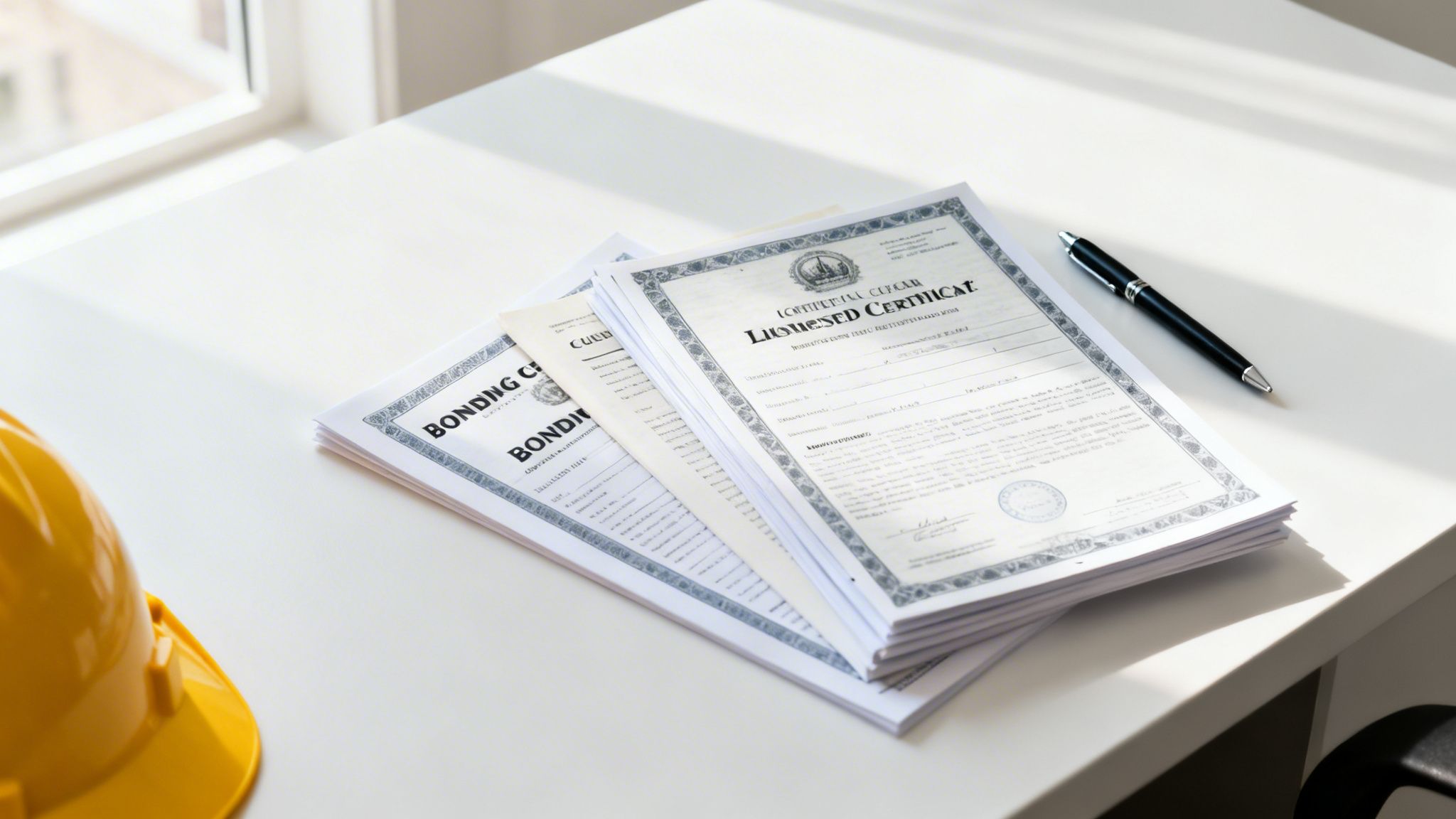
Here’s a quick breakdown of what each document means for your project:
- Licensing: Confirms the contractor has met state or local competency requirements, demonstrating they have the necessary knowledge and experience to manage your project legally. For example, a contractor with over a decade of experience, like FHP Contracting, maintains consistent licensing, showing a long-term commitment to compliance and professional standards.
- Insurance: This includes general liability and worker's compensation. General liability covers property damage, while worker's compensation protects you from being sued if a crew member is injured on your property.
- Bonding: A surety bond protects you if the contractor fails to complete the job, doesn't pay subcontractors, or violates building codes. It ensures you have financial recourse to fix the situation.
Red Flag Alert: Any contractor who is evasive, claims they don't need these documents, or offers a discount to work "under the table" should be immediately disqualified. The minor savings are not worth the immense financial and legal risks.
Actionable Tips for Verification
Before signing any contract, take these verification steps:
- Request physical or digital copies of their current license, certificate of insurance (COI), and surety bond.
- Verify the license independently. Check the status directly with your state’s contractor licensing board, such as the North Carolina Licensing Board for General Contractors.
- Contact the insurance provider. Call the number on the COI to confirm the policy is active, the coverage limits are sufficient for your project’s value, and that it covers the specific scope of work.
- Check the bond amount. Ensure the bond meets or exceeds your project’s total budget.
Asking for this documentation is a standard part of due diligence. This initial step in vetting a contractor is a crucial element in how to choose a general contractor who is reliable, professional, and financially sound.
2. What Is Your Experience with Projects Similar to Mine in Scope, Scale, and Type?
Just because a contractor is licensed and insured doesn't automatically mean they're the right fit for your specific project. Relevant experience is a powerful indicator of future success, so this question helps you gauge a contractor’s direct competency. A firm specializing in commercial build-outs may not have the nuanced skills for a custom home, just as a residential remodeler might be unprepared for the regulatory demands of a government project.
Here's why matching experience to your project type is so important:
- Commercial Development: A contractor like FHP Contracting with a history in retail or office build-outs understands tight deadlines, budget constraints, and minimizing disruption to business operations.
- Government/Public Sector: Experience here signals a deep understanding of public-sector compliance, stringent code requirements, and complex regulatory processes that are non-negotiable.
- Residential & Custom Homes: This work demands a high level of detail, strong client communication, and expertise in managing unique design elements, from custom barndominiums to entire neighborhood developments.
Red Flag Alert: Beware of contractors who claim they can "do it all" but can't provide a portfolio or references for a project like yours. A vague or generalized portfolio often indicates a lack of specialized expertise, which could lead to costly mistakes and delays.
Actionable Tips for Verification
Drill down into their experience with these targeted questions:
- Request specific examples that match your project's type, budget, and square footage.
- Ask for photos and addresses of completed similar projects. You can often see the quality of their past work in their online project gallery.
- Inquire about challenges faced on those projects and how their team successfully resolved them. This reveals their problem-solving abilities.
- Request references specifically from clients whose projects mirrored yours in scale and complexity.
- Clarify their team's experience. Who will be the project manager, and what is their background with your type of construction?
3. How Do You Handle Budget Management, Change Orders, and Cost Overruns?
Understanding a contractor's financial management process is one of the most critical questions to ask a general contractor, as it directly impacts your project's bottom line and overall success. A transparent, well-defined system for handling budgets, changes, and unexpected costs prevents financial surprises and builds trust. A professional contractor should be able to articulate their protocols for tracking expenses, communicating cost increases, and managing financial accountability from start to finish.

Here's what a robust financial management process looks like in practice:
- Detailed Estimates: Instead of a single number, a good contractor provides an itemized bid that breaks down costs for labor, materials, permits, and overhead. This transparency helps you understand where your money is going.
- Formal Change Orders: Any deviation from the original scope of work should be documented in a written change order. This document details the new work, its cost, and its impact on the project timeline, requiring your signature before work proceeds. For example, FHP Contracting's disciplined cost tracking is essential for insurance-backed projects that demand meticulous documentation.
- Proactive Communication: Unexpected issues, like discovering hidden structural problems during a commercial buildout, are common. A reliable contractor communicates these issues immediately, presents solutions with clear cost implications, and works with you to make an informed decision.
Red Flag Alert: Beware of contractors who provide vague, lump-sum estimates or resist putting changes in writing. A "we'll figure it out later" attitude often leads to significant budget overruns and disputes down the road.
Actionable Tips for Financial Clarity
Before work begins, clarify these financial protocols:
- Request a detailed, itemized estimate. Use it to compare bids and as a baseline for budget tracking throughout the project.
- Establish a contingency fund. Set aside 5-10% of the total project cost for unforeseen issues, such as those that might be uncovered during site clearing services. Define what situations trigger its use.
- Clarify the change order process. Ask who is authorized to approve changes and if there are spending limits that require higher-level approval.
- Ask about their supplier relationships. Inquire if they can secure better material prices through bulk purchasing, helping control costs.
- Inquire about financing options. Some contractors, like FHP, offer financing solutions that can provide flexibility for managing project costs and upgrades.
4. What Is Your Timeline for Completing the Project, and How Do You Prevent Delays?
A project's timeline is its pulse, and schedule reliability directly impacts your budget, return on investment, and peace of mind. Asking this critical question reveals a contractor's operational maturity, from their initial planning and resource allocation to their strategies for managing the unexpected. A well-defined schedule is a roadmap that holds everyone accountable and sets clear expectations for completion.
For commercial clients, a delay can mean lost revenue, especially for retail buildouts that must align with seasonal sales cycles. For residential clients, it can mean additional rent and logistical headaches. A contractor who can articulate a clear, realistic timeline and detail their methods for preventing delays demonstrates respect for your time and financial interests.
Red Flag Alert: Beware of contractors who offer an unusually fast timeline without a detailed plan to back it up. Overpromising on the schedule is a common tactic to win a bid, but it often leads to rushed work, cut corners, and eventual, more significant delays.
Actionable Tips for Verification
Before committing, dive deep into their scheduling and risk management practices:
- Request a detailed project schedule. This should outline all major phases, milestones, dependencies, and critical path items, not just a simple start and end date.
- Discuss contingency planning. Ask how they account for common hold-ups like weather, permitting and inspection backlogs, and supply chain disruptions.
- Inquire about crew and subcontractor availability. Confirm they have dedicated resources for your project and that key trades are pre-scheduled to avoid gaps in workflow.
- Clarify communication protocols. Establish how often you will receive schedule updates. Weekly progress meetings are a good standard to maintain transparency.
- Define what constitutes a "delay." Agree on the process for communicating and documenting any changes to the schedule, ensuring you are never caught off guard.
5. How Do You Ensure Quality Workmanship and Safety Compliance on Site?
Beyond the budget and timeline, a contractor’s commitment to quality and safety forms the backbone of a successful project. This question reveals their internal processes, accountability mechanisms, and dedication to protecting both their crew and your investment. A reputable contractor will have well-defined systems for maintaining high standards, ensuring every aspect of the build, from foundation to finish, is executed correctly and safely.
Here's what a contractor's answer should cover regarding their commitment to excellence:
- Quality Workmanship: This goes beyond aesthetics; it's about structural integrity, code compliance, and long-term durability. For custom homes or multi-unit developments, superior craftsmanship reduces future maintenance costs and increases property value. A contractor who, like FHP Contracting, offers a one-year workmanship warranty is demonstrating confidence in their quality.
- Safety Compliance: A safe job site is an efficient job site. Proper safety protocols, including regular training and adherence to OSHA standards, prevent costly delays, protect workers, and minimize your liability. This is especially critical for government contracts and occupied commercial spaces where safety is paramount.
Red Flag Alert: Be wary of a contractor who dismisses safety as "common sense" or lacks a formal quality control process. Vague answers suggest they manage reactively, only fixing problems after they arise, which can lead to project delays, budget overruns, and potential legal issues.
Actionable Tips for Verification
Drill down into their processes with these specific follow-up questions:
- Ask about their safety plan. Request to see their formal safety plan and inquire about the certifications their crew holds (e.g., OSHA-10, OSHA-30).
- Inquire about quality control. Ask about their inspection process, how they manage their punch-list, and how they ensure subcontractors meet their quality standards. A detailed construction quality control checklist is a great indicator of a well-organized team.
- Check their history. Ask if they've ever had a major safety incident or a stop-work order due to code violations.
- Understand their oversight. How do they supervise subcontractors to ensure both safety and quality are maintained consistently across the entire project?
Asking these pointed questions will help you gauge if the contractor truly prioritizes excellence or just talks a good game.
6. How Do You Communicate with Clients Throughout the Project, and How Often?
A contractor's communication style can make or break a project. This question reveals their commitment to transparency, responsiveness, and keeping you informed from groundbreaking to final walkthrough. Consistent, clear communication prevents misunderstandings, manages expectations, and builds a foundation of trust. For commercial projects with tight deadlines or revenue implications, a well-defined communication plan is non-negotiable.

The right communication cadence depends on the project type. A retail buildout may require weekly check-ins to coordinate with tenant operations, while large-scale government projects demand formal, documented protocols. Insurance-backed restorations need detailed progress reports to align with settlement requirements. A proactive contractor will adapt their methods to fit your needs, whether through a client portal, SMS announcements, or scheduled on-site meetings.
Red Flag Alert: Be wary of a contractor who is vague about their communication methods or seems difficult to reach during the initial vetting process. If they are unresponsive before they have your money, that behavior will likely worsen once the project is underway.
Actionable Tips for Verification
Before committing, clarify your communication expectations and get them in writing:
- Establish a primary contact. Ask for a designated project manager and their contact information. Define an escalation procedure for urgent issues.
- Set a regular meeting schedule. Agree on a consistent time for updates, such as a brief call every Monday morning or an on-site walkthrough every other Friday.
- Define communication channels. Will updates be sent via email, text, a project management app, or phone calls? Modern contractors often use client portals and SMS announcements for real-time updates.
- Ask about their tools. Do they use software to share photos, documents, and progress reports? This shows an organized approach.
- Clarify response times. Agree on a reasonable timeframe for them to respond to your questions or concerns, such as within 24 business hours.
Setting these expectations upfront is a critical part of asking the right questions to a general contractor. A detailed communication plan ensures everyone is on the same page, minimizing surprises and keeping your project on track.
7. Can You Explain Your Approach to Managing Subcontractors and Trades?
A general contractor rarely completes an entire project alone. They rely on a network of specialized subcontractors for critical tasks like electrical, plumbing, and HVAC. Asking a potential general contractor about their subcontractor management process is crucial, as it directly impacts the project's quality, timeline, safety, and budget. An organized, well-vetted team of tradespeople is a sign of a professional operation.
Effective management ensures every piece of the project fits together seamlessly. Here’s why this question is so important for different project types:
- Commercial Buildouts: Require precise coordination between trades to install complex systems like fire suppression, data cabling, and HVAC without conflict. A skilled GC prevents costly rework by scheduling trades in the correct sequence.
- Government Projects: These often come with strict compliance requirements for subcontractors, including specific licensing, bonding, and prevailing wage mandates. An experienced firm like FHP Contracting ensures every trade on site meets these rigorous standards.
- Custom Homes & Barndominiums: The quality of specialty finishes, such as custom carpentry or tile work, depends entirely on the skill of the subcontractor. Strong, long-term relationships between a GC and their trades often lead to superior craftsmanship.
Red Flag Alert: A contractor who is vague about their team, cannot name their primary subcontractors, or admits to frequently changing tradespeople may struggle with quality control and scheduling. This instability can introduce major risks and delays to your project.
Actionable Tips for Verification
Before committing, dig deeper into their subcontractor management system:
- Ask about their vetting process. How do they verify a subcontractor's license, insurance, and past work quality before hiring them?
- Inquire about team stability. Ask how long they have worked with their primary electrician, plumber, and HVAC technicians. Longstanding relationships often indicate reliability and mutual respect.
- Understand their quality control. How do they inspect subcontractor work to ensure it meets code and quality standards before the next phase begins?
- Clarify communication and scheduling. How are changes communicated to all trades, and how do they coordinate schedules to prevent on-site conflicts and delays?
This line of questioning is a key part of evaluating how a contractor operates. A well-managed network of subcontractors is a strong indicator of a successful project outcome.
8. What Warranties and Guarantees Do You Offer on Workmanship and Materials?
A project isn’t truly finished the day construction ends. This crucial question addresses the contractor's commitment to quality after they’ve left the site. A warranty is a written guarantee of integrity, protecting your investment from defects in materials or workmanship for a specified period. Understanding these terms upfront prevents future disputes and ensures you have clear recourse if issues arise. A confident contractor will stand behind their work with a solid warranty.
Here’s a breakdown of what to look for in a contractor’s warranty:
- Workmanship Warranty: This covers the labor and installation quality provided by the contractor and their subcontractors. For instance, a one-year workmanship warranty, which is a common standard, protects clients against defects like improperly installed fixtures or faulty framing during the critical first year.
- Material & Manufacturer Warranties: These cover the physical products used, such as roofing, appliances, or HVAC systems. The contractor should help facilitate these warranties, but the manufacturer provides the actual guarantee, which often extends beyond the workmanship warranty.
- Exclusions and Limitations: The warranty should clearly define what isn't covered. This typically includes normal wear and tear, damage from misuse or neglect, or issues arising from a lack of required maintenance.
Red Flag Alert: Be wary of contractors who offer only verbal assurances or provide vague, one-sentence guarantees. A legitimate warranty is a detailed, written document that is formally included in your contract.
Actionable Tips for Verification
Before finalizing your agreement, dig into the details of the warranty:
- Request a written sample of their warranty document to review its terms, duration, and claim process.
- Clarify the duration. The industry standard for workmanship is one year, but some contractors offer longer terms (2-5 years) for certain types of work.
- Understand the claims process. Ask who you should contact, what the expected response time is, and whether they repair or replace defective items.
- Discuss manufacturer warranties. Confirm how these are managed and whether the contractor will assist you in filing a claim with the product manufacturer.
- Ask if the warranty is transferable. This can be a valuable selling point if you plan to sell the property in the near future.
A strong warranty is a sign of a contractor who is proud of their work and committed to long-term client satisfaction, a key part of how to choose a reliable general contractor.
9. How Do You Handle Insurance Claims, Coordination with Adjusters, and Damage Assessment?
For restoration projects following a fire, storm, or flood, the general contractor’s role expands significantly. They must act as a liaison between you and your insurance company. Asking this question reveals their experience with the complex insurance claims process, ensuring they can advocate for you to receive a fair and complete settlement for repairs. A contractor skilled in this area can prevent major delays and financial shortfalls.
Here’s why their experience with insurance work is so important:
- Damage Assessment: A qualified contractor documents all damage, including hidden issues an adjuster might miss. This detailed assessment forms the basis of a comprehensive repair estimate that accurately reflects the full scope of work. For example, water damage from a burst pipe often extends behind walls, requiring more than just surface-level repairs.
- Adjuster Coordination: They speak the same language as insurance adjusters, using industry-standard software and terminology to justify the necessary repairs. This smooths out communication and helps get your claim approved faster.
- Advocacy: An experienced contractor works on your behalf to ensure the insurance company’s approved scope of work covers all required repairs to bring your property back to its pre-loss condition, not just the cheapest fix.
Red Flag Alert: A contractor who asks for payment upfront before the insurance claim is approved or seems unfamiliar with the documentation process may leave you financially responsible for work the insurer won't cover. Avoid anyone who suggests you can "pocket the difference" between their estimate and the insurance payout.
Actionable Tips for Verification
Before committing, confirm their expertise in insurance restoration:
- Ask for references from past clients who had insurance-funded projects.
- Inquire about their process for documenting damage and submitting it to the insurance company.
- Clarify how they handle discrepancies between their estimate and the adjuster’s assessment. Will they file a supplement on your behalf?
- Confirm who on their team is the primary point of contact for the insurance adjuster and how they will keep you informed of progress.
This is a critical question to ask a general contractor when dealing with unexpected property damage. Their ability to manage the claim can be just as important as their ability to perform the physical repairs.
10. What Permits, Inspections, and Contract Terms Are Required and Who Manages Them?
Understanding the administrative side of a construction project is just as important as the physical build. This question addresses the critical paperwork: permits, inspections, and the contract itself. A competent contractor seamlessly manages these processes to ensure your project is legal, safe, and built to code, while a detailed contract protects everyone involved from potential disputes.
The responsibility for these tasks should fall squarely on the general contractor. They are the licensed professional with the experience and local knowledge to navigate building departments and ensure every phase of construction passes inspection. For example, a commercial buildout in Fayetteville, NC, requires specific permits for electrical, plumbing, and occupancy that a knowledgeable local firm like FHP Contracting manages efficiently.
Red Flag Alert: A contractor who asks you to pull the permits yourself is a major warning sign. This often means they are unlicensed or uninsured, and it shifts all legal liability for the project onto you, the property owner.
Actionable Tips for Verification
Before work begins, clarify the entire administrative process to set clear expectations:
- Confirm who obtains permits. The contractor should handle all permit applications and fees, which are then typically billed to you as a project cost.
- Review the contract thoroughly. Request a sample contract to review. Ensure it details the scope of work, itemized pricing, payment schedule, change order procedures, and warranty information.
- Discuss the inspection schedule. Ask who will be on-site to meet with inspectors and how they will communicate the results to you.
- Clarify code compliance. Inquire about their experience with local building codes, especially for unique projects like barndominiums or specialized government contracts with federal requirements.
This is a key question to ask a general contractor because it reveals their professionalism and organizational skills. A well-managed project on paper is essential for a well-executed project on site.
10 Essential Questions to Ask a General Contractor — Comparison
| Item | Implementation complexity | Resource requirements | Expected outcomes | Ideal use cases | Key advantages |
|---|---|---|---|---|---|
| Can You Provide References and Documentation of Your Licensing, Bonding, and Insurance? | Low — request and verify documents | Minimal: time to review and verify with boards/insurers | Legal/financial protection; proof of authority to operate | Any hiring decision; especially public or regulated projects | Reduces fraud risk; provides recourse and compliance proof |
| What Is Your Experience with Projects Similar to Mine in Scope, Scale, and Type? | Medium — review portfolio and references | Moderate: interviews, site visits, document review | Better fit, realistic timelines and budgets | Specialized builds (commercial vs. custom homes) | Matches contractor capability to project needs; lowers performance risk |
| How Do You Handle Budget Management, Change Orders, and Cost Overruns? | High — requires formal processes and controls | High: PM/accounting tools, documentation, contingency funds | Transparent costs, fewer surprises, documented changes | Fixed-budget projects, developers, commercial owners | Prevents unexpected cost escalation; enforces accountability |
| What Is Your Timeline for Completing the Project, and How Do You Prevent Delays? | Medium–High — scheduling and risk mitigation needed | Moderate–High: scheduling software, crew planning, contingencies | Predictable schedule; reduced downtime and conflicts | Time-sensitive buildouts, tenant fit-outs, phased developments | Protects revenue timing; improves milestone visibility |
| How Do You Ensure Quality Workmanship and Safety Compliance on Site? | High — QA programs and safety systems required | High: training, inspections, PPE, oversight staff | Code-compliant, durable work with fewer incidents | Hospitals, multi-unit, government projects, high-risk sites | Lowers liability, reduces rework and warranty claims |
| How Do You Communicate with Clients Throughout the Project, and How Often? | Low–Medium — set communication plan and tools | Low–Moderate: PM tools, designated contact, reporting cadence | Clear expectations, faster issue resolution, documented decisions | Clients needing regular updates; complex or remote stakeholders | Builds trust, reduces misunderstandings and disputes |
| Can You Explain Your Approach to Managing Subcontractors and Trades? | High — coordination, vetting and contractual controls | High: subcontractor screening, scheduling, payment controls | Smoother coordination, consistent quality from trades | Multi-trade commercial projects and large residential builds | Reduces trade conflicts; improves schedule and workmanship |
| What Warranties and Guarantees Do You Offer on Workmanship and Materials? | Low — define and document warranty terms | Low: written policy, claim handling process | Post-completion protection and defined remedies | High-value finishes, resale properties, owner-occupied homes | Provides recourse for defects; demonstrates contractor confidence |
| How Do You Handle Insurance Claims, Coordination with Adjusters, and Damage Assessment? | Medium–High — requires insurance familiarity and documentation | Moderate: damage documentation, adjuster liaison, claims admin | Faster claim resolution, accurate scopes, reduced client cost | Insurance-funded repairs (water, fire, storm damage) | Advocates for full coverage; minimizes out-of-pocket expenses |
| What Permits, Inspections, and Contract Terms Are Required and Who Manages Them? | High — legal/regulatory navigation and contract drafting | High: permit fees, legal review, building-dept coordination | Code-compliant construction and clear contractual protections | Any permitted work, commercial and government projects | Avoids fines/rework; defines responsibilities and dispute resolution |
Building Your Vision with Confidence
Choosing the right general contractor is the most critical decision you'll make for your construction project. It's the pivot point between a stressful, budget-draining experience and a smooth, successful build that brings your vision to life. The ten categories of questions we’ve explored are not just a checklist; they are a strategic framework for due diligence. By moving beyond a simple price comparison, you empower yourself to evaluate potential partners on the metrics that truly matter: transparency, experience, and operational integrity.
A professional, high-caliber contractor will not only welcome these detailed inquiries but will also appreciate your thoroughness. Their ability to provide clear, documented, and confident answers is the first sign of a reliable partner. Vague responses, hesitation, or dismissiveness should be seen as significant red flags. Remember, how a contractor communicates during the interview process is a strong indicator of how they will communicate when your project is underway, and unforeseen challenges arise.
Key Takeaways: From Questions to Clarity
This comprehensive list of questions to ask your general contractor is designed to cut through sales pitches and reveal the core competence of a construction firm. Let's recap the most important principles to guide your final decision:
- Documentation Over Dialogue: Never take a contractor’s word for it. Always request and verify physical or digital copies of their license, bonding, and insurance certificates. This non-negotiable step protects you from liability and financial risk.
- Relevance is Paramount: Experience is only valuable when it’s relevant. A contractor who has built dozens of retail spaces may not be the best fit for your custom home or a public works project. Dig into their portfolio for projects that mirror your own in scale, complexity, and specific requirements, like coordinating with insurance adjusters or navigating government permitting.
- Process Defines Performance: A contractor without established processes for budget management, change orders, safety compliance, and subcontractor oversight is a contractor who manages by crisis. Their answers should reveal systematic, repeatable methods for keeping your project on track and on budget.
- Communication is the Foundation: The communication plan is as vital as the architectural plan. A clear rhythm of updates, a designated point of contact, and a willingness to be accessible are the hallmarks of a client-focused company. This is the bedrock of a healthy working relationship.
Your Actionable Next Steps
With this knowledge, you are prepared to move forward with confidence. The next phase is about implementation. Consolidate your notes from each contractor interview and create a comparison chart. Score each candidate based on their responses to these critical questions, the quality of their references, and your overall impression of their professionalism.
This structured evaluation process removes emotion and gut feelings from the equation, allowing you to make a data-driven decision. The goal isn't just to find a builder; it's to secure a project partner who will act as a steward of your investment, a manager of your risk, and a champion for your vision. Mastering this vetting process is the single most effective action you can take to ensure your project's success, protecting your financial resources and your peace of mind from start to finish. The confidence you build during this selection phase will carry you through every milestone, from groundbreaking to final walkthrough.
For clients in Southern North Carolina seeking a general contractor who values this level of transparency and accountability, FHP Contracting is ready to answer every one of these questions. We build our client relationships on a foundation of clear communication and proven processes. To discuss your project and see how our commitment to quality can bring your vision to life, we invite you to request a free consultation.