

So, you’re thinking about getting into government contracting. That’s a smart move. For businesses here in Southern North Carolina and really, anywhere in the country, it represents a massive opportunity for stable, long-term growth.
But I get it. The whole thing can seem like an impossible maze of rules, paperwork, and acronyms. A lot of great entrepreneurs get overwhelmed and walk away before they even start. The secret is to stop seeing it as a barrier and start seeing it as a structured path with clear, manageable steps.
Success in this world really boils down to getting three things right. I call them the Three Pillars of Readiness.

To make this crystal clear, here’s a simple breakdown of what these pillars are and why they're your starting line.
The Three Pillars of Government Contracting Readiness
| Pillar | What It Means | Why It's Your First Step |
|---|---|---|
| Registration | This is how you put your business on the government's radar. Think of it as creating your official profile so contracting officers can find you, vet you, and ultimately pay you. | If you're not registered, you're invisible. It's the non-negotiable first step to even be considered for a contract. |
| Compliance | This is where you prove your business is a reliable and ethical partner. It means having the right insurance, being financially stable, and understanding the basic rules of play. | The government needs to know you can be trusted with taxpayer money. Compliance shows you’re a professional, low-risk choice. |
| Qualification | This is you showing you’ve got the chops to actually do the work. It’s about showcasing your past projects and, for many small businesses, using special programs to get a leg up on the competition. | It's not enough to be registered; you have to prove you’re capable. This is how you stand out from the crowd and win the bid. |
Nailing these three areas is what separates the businesses that win contracts from those that just spin their wheels. It’s the foundation for everything else.
More Than a Job—It’s a Strategic Partnership
The sheer scale of government spending is hard to wrap your head around. In Fiscal Year 2024 alone, the federal government set aside $755 billion for contracts. That number isn't just big; it's strategic. Agencies are laser-focused on efficiency, national security, and new technology, which means they're demanding more from their contractors.
What this really means is the government isn’t just looking for someone to do a job anymore; they’re looking for a genuine partner. The businesses that can prove their value, show up reliably, and bring real expertise to the table are the ones who are going to clean up in this market.
By getting these fundamentals down, you’re building a rock-solid foundation for long-term success. This guide is designed to walk you through each requirement, step-by-step, turning what feels like a bureaucratic nightmare into a clear, achievable roadmap.
Whether your goal is to win federal, state, or local work, it all starts here. For companies ready to jump in, understanding how to deliver on government projects is the perfect next step. The journey begins now, with getting your business ready to compete and win.
Your First Steps: Getting Registered and Identified
Before you can even think about bidding on a government project, you have to get on the government’s radar. I like to think of it like this: you wouldn’t show up for a job interview without a resume, right? Well, you can't do business with the federal government without an official, verified profile. This initial registration is where many businesses stumble right out of the gate, but it's absolutely fundamental.
Let’s walk through these first few critical steps. It all begins with getting your business its own unique ID.
Securing Your Unique Entity Identifier (UEI)
The very first piece of the puzzle is your Unique Entity Identifier, or UEI. It's a 12-character alphanumeric code that acts as the government's primary tracking number for your business. Think of it as a Social Security Number, but for your company in the federal marketplace.
In the past, you might have heard of something called a DUNS Number. The government has since moved away from that system to the UEI, which actually simplifies things. The best part? You no longer have to go to a third-party website to get it.
Your UEI is assigned for free directly through the System for Award Management, or SAM.gov. When you start your registration there, one of the first things the system does is generate your UEI. From that point on, every federal agency will use this single identifier to track payments, performance, and contract awards tied to your company.
Mastering the System for Award Management (SAM.gov)
Once you have your UEI, the main event is completing your registration in the System for Award Management (SAM.gov). If the UEI is your ID card, SAM.gov is your official business resume for federal agencies. It's the massive, centralized database where contracting officers go to find and vet potential contractors just like you.
An incomplete or sloppy SAM profile is a huge red flag for a contracting officer. To get your profile up to par, you'll need to have this information ready:
- Business Information: Your legal business name, physical address, and corporate structure (LLC, S-Corp, etc.).
- Financial Details: Your bank account information for direct deposit payments and your Taxpayer Identification Number (TIN).
- Points of Contact: Who in your company is responsible for government business, accounts receivable, and other key roles.
Let me be clear: Registering on SAM.gov is non-negotiable. Without an active and complete profile, you are simply invisible and ineligible to receive a federal contract award. It’s the digital handshake that makes you a real, viable candidate for government work.
Your SAM registration isn't a one-and-done task; it has to be renewed every single year. If you miss this deadline, your profile becomes inactive. That means you could be instantly disqualified from bidding on new contracts or even receiving payments for work you're already doing. Set a calendar reminder—this is one of those small details you just can't afford to let slip.
Finding Your Niche with NAICS Codes
As you work through your SAM profile, you'll be asked to provide your North American Industry Classification System (NAICS) codes. Don't let the long, official-sounding name intimidate you. NAICS codes are just "business category tags." They are six-digit codes that classify your business based on the specific services or products you offer.
For instance, a general contractor who primarily works on commercial buildings would use the code 236220 (Commercial and Institutional Building Construction). A company that specializes in roofing would use 238160 (Roofing Contractors).
So why do these codes matter so much? Because contracting officers use them to search for qualified businesses. If an agency needs a new HVAC system for a federal building in Fayetteville, they aren't going to search for "air conditioning guys." They're going to pull up a list of all businesses registered under the NAICS code 238220 (Plumbing, Heating, and Air-Conditioning Contractors).
You can, and absolutely should, list multiple NAICS codes that fit your business. Pick one primary code that represents the bulk of your work, but be sure to add secondary codes for every other service you're qualified to provide. Getting your codes right is a core requirement that literally determines whether you even show up in the right searches for the right opportunities.
Meeting Financial and Legal Compliance Standards
Once you’re officially registered, the government knows your name. Now comes the part where you prove you’re a partner they can trust. This is where financial and legal compliance enter the picture, and these aren’t just friendly suggestions. They are non-negotiable government contracting requirements designed to show you have the financial muscle and stability to see a project through to the very end.
This layer of due diligence is so critical because government work is funded by taxpayer dollars. That means accountability and minimizing risk are always top priorities for the agency. The sheer scale of this spending is staggering. In 2023, public procurement spending across OECD countries hit 12.7% of GDP. For nations in the OECD-EU, that number jumped to 14.8% of GDP. When you see figures like that, it’s easy to understand why the government puts contractors under such a microscope.
The Financial Safety Net of Bonding
Think of bonding as a financial safety net for the government, provided by you. It's essentially a promise from a third-party company—called a surety—that you have the financial backing to get the job done. If something goes sideways and you can’t finish the work, the bond protects the government from taking a financial hit.
You'll run into three main types of bonds out in the wild:
- Bid Bonds: You submit this with your bid. It’s your guarantee that if you’re the winning bidder, you’ll actually take the job and secure the other necessary bonds. It stops companies from winning a contract and then backing out.
- Performance Bonds: This is the big one. It guarantees that you will complete the project exactly as spelled out in the contract. If you default, the surety company has to step in and make sure the work gets finished.
- Payment Bonds: This bond is your promise to pay every single subcontractor, laborer, and material supplier on your project. It’s crucial protection for your partners and prevents liens from being slapped on government property.
For most federal construction projects over $150,000, the Miller Act makes performance and payment bonds mandatory. Proving you are "bondable" is one of the first and most significant financial hurdles you'll need to clear.
Essential Insurance Coverage
Right alongside bonding, you’ll need to carry specific kinds of insurance. These policies are there to protect your business, your team, and the public from the accidents or mistakes that can happen on a job site. The exact requirements will change from contract to contract, but a few standard policies are almost always on the list.
A rookie mistake is thinking your regular commercial insurance policy will cut it. Government contracts often demand much higher coverage limits or even additional policy types you might not carry. Always, always read the insurance clause in the solicitation with a fine-tooth comb.
You can pretty much count on needing:
- General Liability Insurance: This covers claims from third parties for things like bodily injury or property damage.
- Workers' Compensation: As required by state law, this covers medical bills and lost wages for any of your employees who get hurt on the job.
- Automobile Liability: This covers any vehicles you use for business.
These deeper financial requirements all build on the foundational registration steps you have to take first.
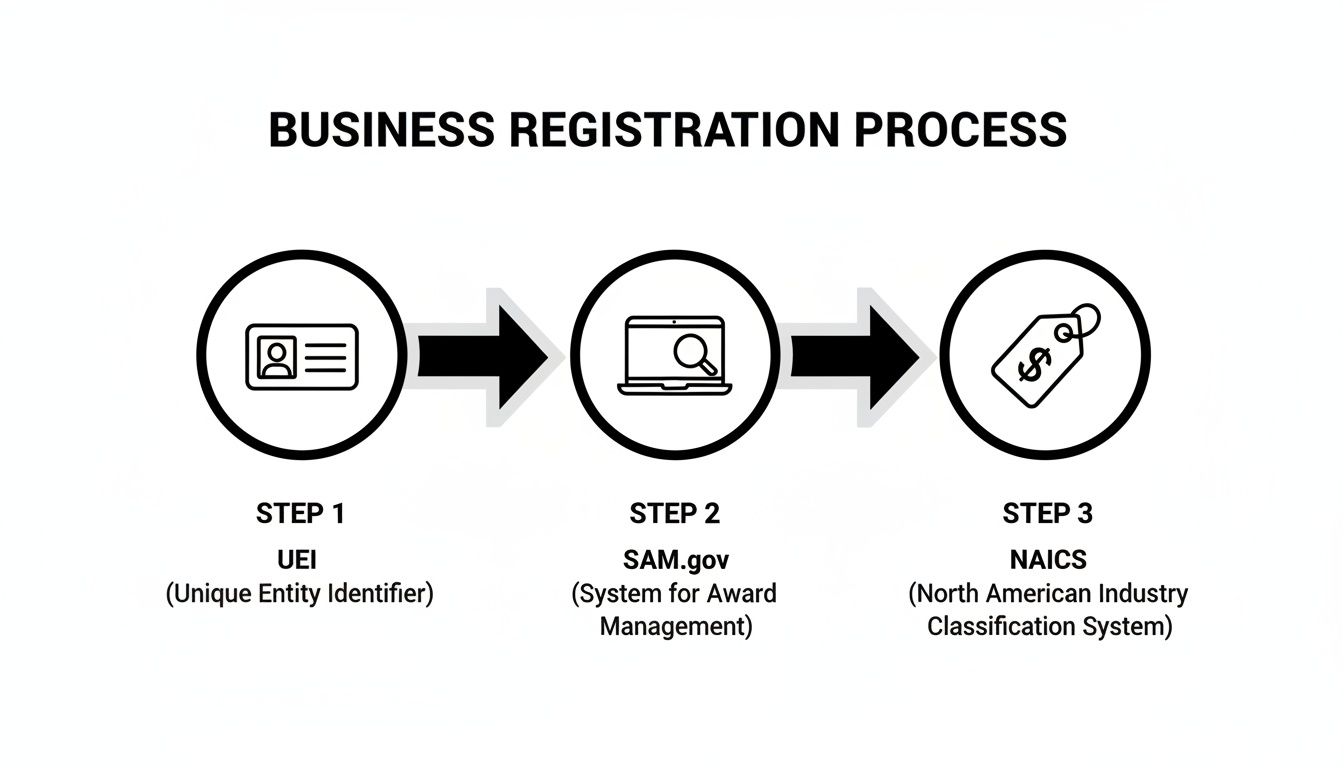
As you can see, getting your UEI, registering in SAM.gov, and figuring out your NAICS codes are the absolute first things you have to do. You can't even begin to prove you have bonding and insurance until those are squared away.
Understanding the Rulebook: The Federal Acquisition Regulation
Finally, let's talk about the legal framework that governs pretty much every dollar the federal government spends: the Federal Acquisition Regulation (FAR). It looks like a huge, intimidating legal tome, and honestly, it can be. But it’s best to just think of it as the official "rulebook of the game."
The FAR lays out exactly how the government buys things and the principles every contractor has to live by. You don't need to memorize all 53 parts of it, but you absolutely have to get a handle on the core concepts. We’re talking about standards for ethical conduct, fair pricing, keeping proper records, and quality control. For construction, a rock-solid quality control plan is a deal-breaker, and our guide on a construction quality control checklist can help you build a system that meets these tough standards.
If you’re bidding on a job with the Department of Defense, you’ll also see references to the DFARS (Defense Federal Acquisition Regulation Supplement). This adds another layer of military-specific rules to the mix. Getting familiar with the relevant FAR and DFARS clauses in a solicitation isn’t just good practice—it's a fundamental requirement of being compliant.
Using Set-Asides to Gain a Competitive Edge
How can a small business in Southern North Carolina possibly go toe-to-toe with a national construction giant and actually win? It’s one of the biggest questions I hear. And the answer often boils down to one of the most powerful tools in your arsenal: socio-economic set-aside programs.
A lot of new contractors get this wrong. They see these programs as some kind of government handout. That’s the wrong way to look at it. Think of them as the government’s way of making sure its supplier base is diverse and healthy. By setting aside specific contracts for certain types of small businesses, Uncle Sam levels the playing field so that huge, established firms don't gobble up every single job.
This isn’t just a nice idea; it's baked into federal law. The government is legally required to award a big slice of all contract dollars to small businesses. For Fiscal Year 2023, the Small Business Administration (SBA) reported a record-smashing $178.6 billion went to small businesses. They hit their goal of awarding 23% of prime contracting dollars to small firms. What this means for you is that there’s a massive pool of work where your only competition is other businesses just like you.
The Power of Limited Competition
The real magic of a set-aside contract is limited competition. Instead of your proposal being one of 50 in a stack that includes massive corporations, it might be one of just a handful from businesses of a similar size. That move right there dramatically boosts your odds of winning.
For so many small businesses, their very first prime contract win comes directly through a set-aside. It’s the single most effective way to get your foot in the door, start building that all-important past performance, and make a name for yourself with a government agency.
Qualifying for one or more of these programs is a huge part of nailing your government contracting requirements and setting your business up for the long haul. Let’s break down the programs that will make the biggest difference.
The Most Common Set-Aside Programs
The Small Business Administration (SBA) is the gatekeeper for several key certification programs. Each one has its own rules and its own unique perks.
- Small Disadvantaged Business (SDB) / 8(a) Business Development Program: This is a seriously powerful nine-year program built to help firms owned by socially and economically disadvantaged folks. If you get into the 8(a) program, you can be awarded sole-source contracts—meaning no competition—up to $4.5 million for services and $7 million for manufacturing.
- Historically Underutilized Business Zone (HUBZone) Program: This program is all about sparking growth and creating jobs in economically distressed communities. To qualify for the HUBZone program, your main office has to be in a designated HUBZone, and at least 35% of your employees have to live in one, too. The government’s goal is to award 3% of all federal prime contracts to HUBZone firms every year.
- Women-Owned Small Business (WOSB) Federal Contracting Program: The WOSB program is designed to create a level playing field for women entrepreneurs. The government’s target is to give at least 5% of federal contracting dollars to WOSBs annually. To get in, your business has to be at least 51% owned and controlled by one or more women who are U.S. citizens.
- Service-Disabled Veteran-Owned Small Business (SDVOSB) Program: This program is specifically for businesses owned by veterans who were disabled during their military service. The government sets an annual goal to award 3% of all prime contract dollars to SDVOSBs. Just like the WOSB program, the business must be at least 51% owned and controlled by one or more service-disabled veterans to qualify for the SDVOSB program.
For businesses here in our area, especially near Fort Liberty (what we all still call Fort Bragg), the SDVOSB certification can be a game-changer because of the sheer volume of Department of Defense work. Figuring out which of these programs you qualify for is a critical first step. It takes you from being just another bidder in the crowd to a preferred candidate for a specific, protected piece of the market.
Crafting a Winning Proposal to Secure Contracts

You’ve mastered all the registrations and checked off the compliance boxes. Now it's time to shift from being eligible to actively winning work. This is where the rubber meets the road—finding opportunities and writing proposals that convince a government agency you are, without a doubt, the best choice.
The federal market today is looking for more than just the lowest bidder. According to one key industry metric, the Government Contractor Confidence Index recently dipped to 138.0, its lowest point in six years. This signals a more cautious environment where agencies are scrutinizing contractor performance more than ever.
Even so, over half of all contractors still saw their revenue grow, which proves that adaptable, resilient firms are finding ways to thrive. You can dig into more of these findings in the 2025 Clarity Government Contracting report from Deltek.com.
Finding and Analyzing Opportunities
Your hunt for contracts will almost certainly start on platforms like SAM.gov, the main hub for federal opportunities. But simply finding a listing isn’t enough. The real skill is learning to analyze a solicitation—the government’s formal request for proposals (RFP) or quotes (RFQ)—to truly understand what the agency needs.
Think of a solicitation not as a simple job posting, but as a detailed instruction manual and a test all rolled into one. It tells you exactly what the agency requires, how they want you to format your proposal, and precisely how they will score it. Ignoring these details is the fastest way to get your bid tossed right into the "no" pile.
When you're breaking down a solicitation, zoom in on these sections:
- Statement of Work (SOW): This is the heart of the project. It describes the actual work to be done—the "what."
- Evaluation Criteria (Section M): Think of this as the scoring rubric for your test. It tells you exactly what factors the government will use to judge proposals, like your technical approach, past performance, and price.
- Instructions to Offerors (Section L): These are the rules of the game. It provides all the formatting and submission guidelines. Missing a single requirement here often means automatic disqualification.
The Key Components of a Winning Proposal
A winning proposal is much more than a price quote; it’s a persuasive argument that demonstrates your value. It’s your chance to show the contracting officer that you understand their problem and are the lowest-risk, most capable partner to solve it. A truly compelling bid goes beyond just meeting the minimum government contracting requirements—it tells a story of competence and reliability.
A common mistake is getting fixated on offering the lowest price. While cost is always a factor, many government contracts are awarded based on a "best value" determination. This means the agency is weighing your technical skill and past success right alongside your price tag.
You need to structure your proposal to make it easy for evaluators to see your strengths. This means a clear, well-organized document with distinct parts is non-negotiable.
Building Your Proposal Structure
A standard government proposal is usually broken down into three main volumes.
- The Technical Volume: Here, you explain how you'll do the work. This section needs to address every single point in the SOW, outlining your specific methodology, project management plan, quality control processes, and who you'll have on your team. Be specific and confident.
- The Past Performance Volume: This is your proof. You’ll provide details on 3-5 similar projects you’ve successfully completed. For each one, you must describe the scope, the outcome, and provide a point of contact who can vouch for your work. Strong, relevant past performance is often the most heavily weighted factor in an evaluation.
- The Cost/Price Volume: In this section, you break down your pricing in the exact format the solicitation demands. Your numbers have to be detailed, logical, and align perfectly with the work you described in your technical volume. Transparency here is absolutely critical to building trust.
Your Government Contracting Readiness Checklist
Jumping into government contracting can feel like you're trying to assemble a 1,000-piece puzzle without the picture on the box. But here’s the secret: success is all about being methodical. Think of this checklist less like a chore list and more like your project plan for getting your business truly "contract-ready." It takes all those critical requirements we've been talking about and breaks them down into real, actionable steps.
If you follow this path, you’ll build a rock-solid foundation, piece by piece, preparing your business not just to compete, but to win. Let's walk through the journey in three phases.
Phase 1: Initial Business Setup
First things first, you have to get your own house in order. Before you can even think about knocking on the government's door, your business needs to be structured correctly with all the essential legal and financial paperwork squared away. These are the absolute, non-negotiable basics.
- Confirm Business Structure: Make sure your business is a properly registered legal entity, like an LLC, S-Corp, or Corporation.
- Obtain Federal Tax ID (EIN): You'll need an Employer Identification Number from the IRS for just about everything in the federal space.
- Set Up a Business Bank Account: Government payments can't go to a personal account. You need a dedicated business bank account.
- Secure a Business Domain and Email: Professionalism is key. An email like
[email protected]sends a much better signal than a generic Gmail or Yahoo address.
Phase 2: Federal Registration and Certification
Alright, with the basics handled, it’s time to get on the government's radar. This phase is all about the mandatory registrations that make you visible and eligible to even be considered for federal work. If you miss a step here, you’re basically invisible to contracting officers.
A word of warning: these systems are not "set it and forget it." Many registrations require you to renew them annually. If you let one lapse, you could become ineligible overnight and lose out on a major contract you were perfect for.
- Obtain Your Free UEI: Head over to SAM.gov to request your Unique Entity Identifier. This is your primary ID across the entire federal government.
- Complete Your SAM.gov Registration: Create a full, accurate, and detailed profile in the System for Award Management. Don't cut corners here.
- Identify Your NAICS Codes: Figure out all the North American Industry Classification System codes that describe what your business does. Be thorough!
- Explore Set-Aside Certifications: Look into whether you qualify for special programs through the SBA, like 8(a), HUBZone, SDVOSB, or WOSB. These can give you a serious competitive edge.
Phase 3: Bid Preparation Readiness
Now that you're registered, this final phase is about getting you ready to actively hunt down and win contracts. It involves proving you’re financially stable and having your key documents polished and ready to go. That way, when the right opportunity pops up, you can move fast.
- Verify Your Bonding Capacity: Call a surety agent and find out your bonding limit. You absolutely have to know this number before you even think about bidding on a construction project.
- Review Your Insurance Coverage: Check that your general liability, workers' compensation, and auto policies meet the typical standards required for government jobs.
- Compile Past Performance Data: Get a document ready with the details of 3-5 relevant projects you’ve completed. Include client names and contact info for references.
- Develop a Capabilities Statement: This is your one-page marketing powerhouse. It needs to crisply summarize your core skills, what makes you different, and your track record.
As a general contractor with years of boots-on-the-ground experience, our team knows what it takes to meet these demands. We offer a wide range of construction and contracting services that are built for this world. Consider this checklist your starting point for building a winning government contracting operation.
Common Questions About Government Contracting Requirements
Jumping into government contracting always kicks up a lot of practical, on-the-ground questions. Even after you get the big picture, you're going to face real-world scenarios that feel a bit fuzzy. We get it. Here are some straightforward answers to the questions we hear all the time, designed to help you push forward with confidence.
How Long Does SAM.gov Registration Actually Take?
This is a big one. You can probably knock out the online forms in a few hours, assuming you have all your ducks in a row (your UEI, tax ID, banking info, etc.). But that's just step one. The real waiting game begins with the federal validation process.
That part can take anywhere from a handful of business days to a few weeks for the government to give your profile the green light. To be safe, plan on starting your registration at least one full month before you even think about bidding on a contract. And remember, this isn't a one-and-done deal; you have to renew it every year to stay active and eligible.
Do I Need Prior Government Experience to Win?
Nope, but you absolutely have to prove you know what you're doing. Think of it this way: if you're a construction company bidding on a federal building renovation, every successful commercial project you've completed is proof of your capabilities.
You need to showcase those projects in your proposal to demonstrate you have the skills and stability the government requires. Another fantastic strategy is to start as a subcontractor for a seasoned prime contractor. It’s a great way to build a portfolio of federal project experience before you start leading your own bids.
The single biggest mistake new contractors make is submitting a non-compliant proposal. Government solicitations have rigid, unbending instructions. One missing form, a misread requirement, or a submission that’s one minute late can get you automatically disqualified.
I always tell people to create a custom checklist based on that specific solicitation's rules (usually found in Section L of the RFP) and then triple-check every last detail before hitting "submit."
Is Free Help Available to Navigate These Requirements?
Yes, and you should definitely use it. The APEX Accelerators program, which you might know by its old name, PTAC, is a nationwide network that provides free or low-cost counseling to businesses trying to break into government contracting.
These folks are experts who can help you make sense of regulations, find opportunities, and even review your proposals. They are an invaluable resource, especially when you're new to the federal marketplace. For more answers, you can also check out our Frequently Asked Questions page.
At FHP Contracting, we have over a decade of experience meeting the demanding standards of government work right here in Southern North Carolina. If you’re ready to partner with a contractor who understands the process from start to finish, request your free consultation today.