
When people ask me, “What does it cost to build a house around here?” I always start with the same answer: it depends. In Southern North Carolina, you’re generally looking at a range from $175 to over $350 per square foot.
But that number is just a starting point. The final price tag hinges on a huge number of variables, like the quality of your finishes, the complexity of the design, and what we find when we start digging into your specific piece of land.
Your Quick Guide to North Carolina Home Building Costs
Think of building a custom home like ordering a car from the factory. You can stick with the reliable base model, go all-out with every luxury feature imaginable, or find a sweet spot somewhere in the middle. Each choice you make, big or small, affects the final price. The very first step in creating a realistic budget is figuring out which "trim level" you're aiming for.
The cost-per-square-foot metric is the industry standard for a reason. It’s a reliable way to get a ballpark figure right from the start, helping you match the size of your dream home to the reality of your budget before you get too far down the road.
Understanding Specification Levels
When a builder talks about "specification level," we're really just talking about the overall quality and complexity of your home. An economy-level build is all about function and efficiency. A high-end custom home, on the other hand, is where you see unique architectural designs and top-of-the-line luxury materials. Most folks land somewhere in between, mixing quality finishes where it counts with more budget-friendly choices elsewhere.
Your final cost is the sum of thousands of small decisions. For example, the price difference between standard vinyl windows and premium wood-clad windows might seem small for one window, but it adds up to a significant amount across an entire house.
To give you a better sense of how this works, here’s a breakdown of the typical cost ranges you’ll see in Southern North Carolina. This table should help you visualize how different tiers of finishes translate into real-world numbers.
Estimated New Home Construction Costs in Southern NC Per Square Foot
Use this table as a general guide to estimate building costs based on your desired level of finishes and architectural complexity.
| Home Specification Level | Estimated Cost Per Square Foot | Example 2,500 Sq. Ft. Home Cost |
|---|---|---|
| Starter / Economy | $175 – $225 | $437,500 – $562,500 |
| Mid-Range / Upgraded | $225 – $285 | $562,500 – $712,500 |
| High-End / Luxury Custom | $285 – $350+ | $712,500 – $875,000+ |
These numbers are a powerful tool for your initial planning. Right away, you can see that a $600,000 budget could get you a beautifully appointed 2,500-square-foot mid-range home. Or, if size is your main priority, that same budget might build a larger 3,000-square-foot house with more basic, builder-grade finishes.
Of course, this is just scratching the surface. To really get a handle on your budget, you need to understand where the money goes during each phase of construction. The more you learn, the more confident you'll feel about the whole process. You can learn more about FHP Contracting's commitment to building exceptional custom homes right here.
And one last thing to remember: these figures are for the construction itself. They don't include the cost of the land, which can vary wildly depending on the location.
Deconstructing Your New Home Construction Budget
Thinking about cost per square foot is a great place to start, but to really get a handle on what it costs to build a house, you have to look under the hood. You need to see where every dollar is actually going.
I like to think of the total budget as a big pizza. Each slice is a major phase of construction, and some of those slices are just naturally going to be bigger than others. Breaking down one massive, intimidating number into a series of smaller, more manageable categories is empowering. It lets you have smarter conversations with your builder, figure out where you want to spend your money, and make trade-offs that feel right for you.
This diagram is a great way to see how the choices you make—from a straightforward starter build to a complex custom project—shape the final price tag.

The real takeaway here is that as you climb the ladder from starter to luxury, it’s not just that the numbers get bigger. The project itself becomes more complex, with a larger portion of the budget shifting towards sophisticated systems and high-end finishes.
The Big Slices of the Budget Pie
Your new home’s budget can be carved up into a handful of core categories. The exact percentages will move around based on your specific lot and design, but this gives you a solid framework for what to expect.
Here’s a look at the major phases of construction and how much of the budget they typically claim.
A detailed budget is your roadmap. The table below shows how a typical custom home budget is allocated, giving you a clearer picture of where your investment goes at each stage.
Typical Budget Allocation for a Custom Home Build
| Cost Category | Percentage of Total Budget (Approx.) | Key Components |
|---|---|---|
| Site Work, Foundation, & Flatwork | 10% – 15% | Land clearing, grading, excavation, pouring the slab or building the crawlspace/basement, utility trenching. |
| Framing & Exterior Shell | 30% – 35% | Lumber and labor for walls, floors, and roof; siding, roofing materials, windows, and exterior doors. |
| Major Systems (MEP Rough-Ins) | 10% – 15% | Plumbing lines, electrical wiring, and HVAC ductwork installed within the walls and ceilings. |
| Interior Finishes | 25% – 30% | Insulation, drywall, flooring, paint, cabinets, countertops, fixtures, tile, and appliances. |
| Final Items & Other Costs | 10% – 15% | Landscaping, driveways, final cleanup, builder overhead/profit, permits, and your contingency fund. |
This breakdown isn't set in stone, but it's a reliable guide. Knowing these percentages helps you ask the right questions and understand why certain phases command a larger share of the total cost.
How One Decision Creates a Ripple Effect
It's crucial to understand that none of these categories exist in a vacuum. A decision you make in one area will almost certainly send ripples into others.
For example, let's say you fall in love with a complex roofline with lots of gables and dormers. That doesn’t just increase your roofing material costs. It also makes the framing job much more intricate and slower, driving up labor costs.
Similarly, if you choose a heavy, oversized tile for the primary bathroom, your builder might need the framers to add extra support to the floor joists below. It’s a small change, but it’s a real cost that needs to be accounted for.
Building a home is a system of dependencies. A quality-focused builder sees these connections and plans for them, preventing surprise costs and ensuring structural integrity from the ground up.
The Bigger Economic Picture
Beyond your personal choices, broader economic forces are always at play. The cost of materials and the availability of skilled labor are in constant flux.
Right now, overall U.S. construction costs are up, driven by everything from labor shortages to supply chain issues. When a commodity like copper surges—it was up 36% year-over-year recently—it directly impacts the cost of your electrical and plumbing systems. Being aware of these market trends helps you set a realistic budget from day one.
Maintaining high standards through every phase is how you protect your investment and get the home you’ve dreamed of. If you want a closer look at the checks and balances we use on our own job sites, you can review our guide on the construction quality control checklist. It’s a behind-the-scenes peek at how paying attention to detail in every one of these budget categories leads to a far superior home.
How Market Volatility Affects Your Building Costs
When you’re dreaming up your new home, it’s easy to focus on architectural plans and countertop choices. But the final price tag is shaped by forces happening far outside your property lines. The estimated cost to build a house is a moving target, heavily influenced by two big variables: the global market for materials and the local market for skilled labor. Getting a handle on these dynamics is the key to setting a realistic budget and navigating the build with your eyes wide open.
Think of the materials market like the stock market. Prices for essentials like lumber, steel, and copper are constantly in flux, pushed and pulled by supply and demand, trade policies, and even global events. One day, prices are steady; the next, a supply chain hiccup or a new tariff sends them soaring.
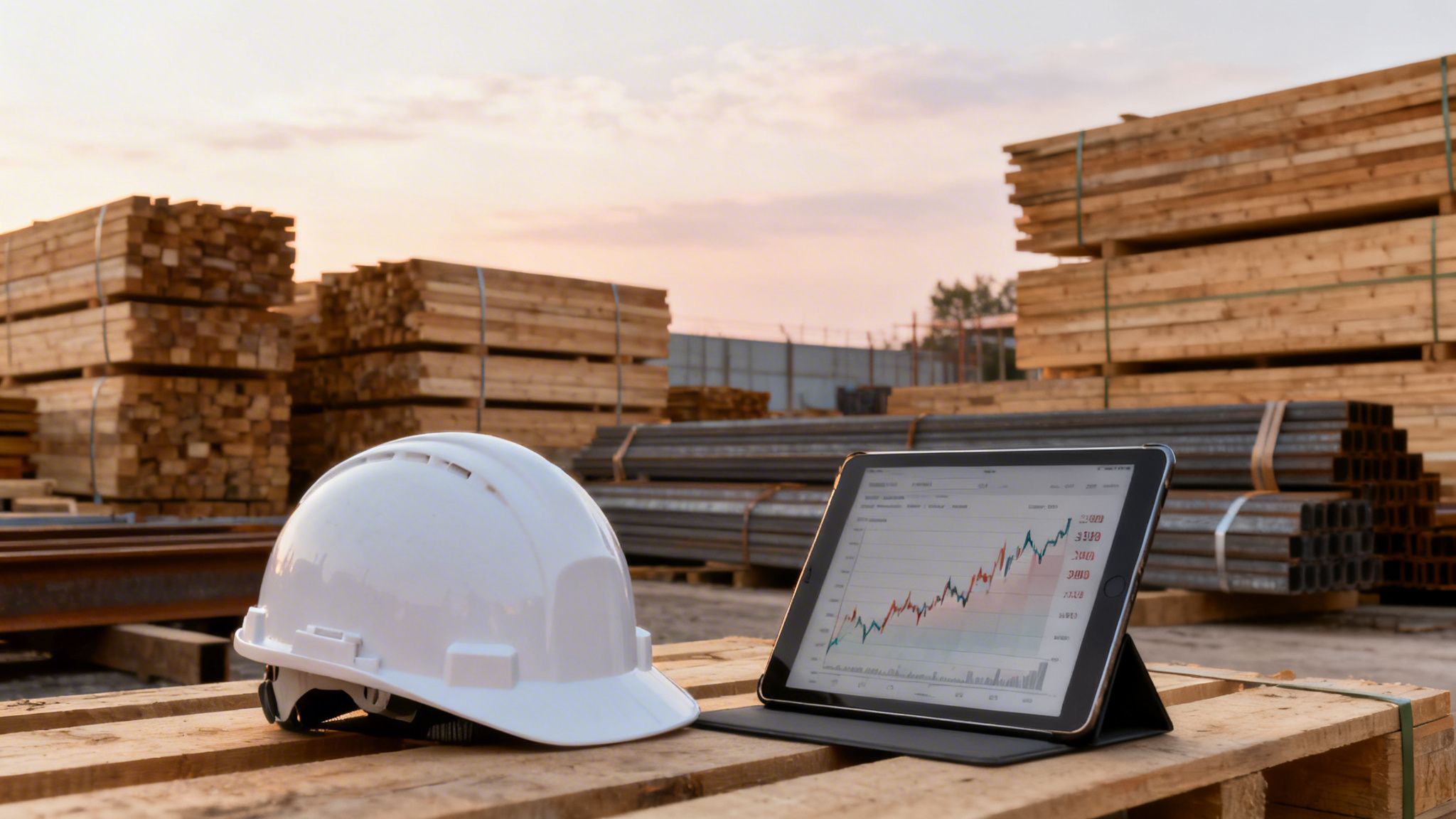
This is exactly why a quote you got six months ago might not hold up today. It’s not a bait-and-switch from your builder; it’s that the real-world cost of the raw ingredients for your home has genuinely changed.
The Ever-Changing Price of Materials
Commodities are the raw ingredients of your home, and their prices can be wild. When we talk about these, we mean the fundamental stuff that forms the skeleton and systems of your house.
- Lumber: This is the backbone of most residential framing, making its price a huge budget factor. Prices can swing wildly based on everything from sawmill capacity and wildfire seasons to international trade spats.
- Steel: Used for rebar in your foundation and structural beams, steel prices are tied to global industrial demand and production.
- Copper & Aluminum: These metals are non-negotiable for your electrical wiring, plumbing pipes, and even some roofing or siding. Their prices often follow industrial and tech growth across the world.
Recent trends show just how crazy these swings can get. For instance, steel mill products have seen a 16% domestic price hike due to a complex mix of weakening demand and international competition. That directly bumps up the cost of your home's foundation and framing.
Likewise, aluminum recently shot to a three-year high of $2,800 per ton, and architectural copper is projected to hit nearly $12,500 per metric ton soon, mostly thanks to supply shortages. Those increases ripple straight into the cost of your electrical and plumbing systems. You can read more about these projections and their impact on future home construction costs.
A savvy builder knows this volatility is part of the game. By nurturing strong, long-term relationships with multiple suppliers, they can often lock in better pricing and more reliable access to materials, shielding your project from the worst of the market's mood swings.
Honestly, this is a huge part of a contractor’s job—managing the supply chain to keep your project on track and on budget as much as humanly possible.
The Local Labor Market Squeeze
The other big variable is the cost and availability of skilled labor. A quality home doesn't build itself. It needs a whole team of pros: framers, electricians, plumbers, roofers, and a dozen other trades. In a booming market like we’ve had here in North Carolina, the demand for these skilled workers often runs way ahead of the supply.
This creates a competitive scramble where builders have to pay more to attract and keep top talent. When the labor pool is tight, the price for their expertise naturally climbs, and that increase shows up in your project’s bottom line.
But it’s not just about cost; it’s about quality. An experienced framing crew might cost more per hour, but they work faster and make fewer mistakes, which can actually save you money and future headaches. On the flip side, hiring a cheaper, less-experienced crew might look good on paper, but it can lead to expensive errors, failed inspections, and delays that blow your budget out of the water.
Ultimately, your builder is the one who has to steer the ship through these choppy market waters. Their skill in managing material purchasing and assembling a reliable, talented team is one of the most valuable things they bring to the table. It’s what turns a potentially volatile process into a predictable and successful build.
Planning For The Overlooked Costs Of Building A Home
When you start dreaming about your custom home, it’s easy to focus on the tangible stuff—the framing going up, the drywall getting finished, the beautiful kitchen being installed. That construction estimate is the heart of your budget, for sure, but it’s not the whole story.
Focusing only on the cost of sticks and bricks is like planning a road trip but forgetting to budget for gas, tolls, and that unexpected flat tire along the way. To build a truly accurate budget, you have to account for the “soft costs”—all the essential but often invisible expenses that happen before, during, and after the physical build. These are the professional services and administrative fees that make the whole project possible. Honestly, overlooking them is the number one reason I see budgets go completely off the rails.
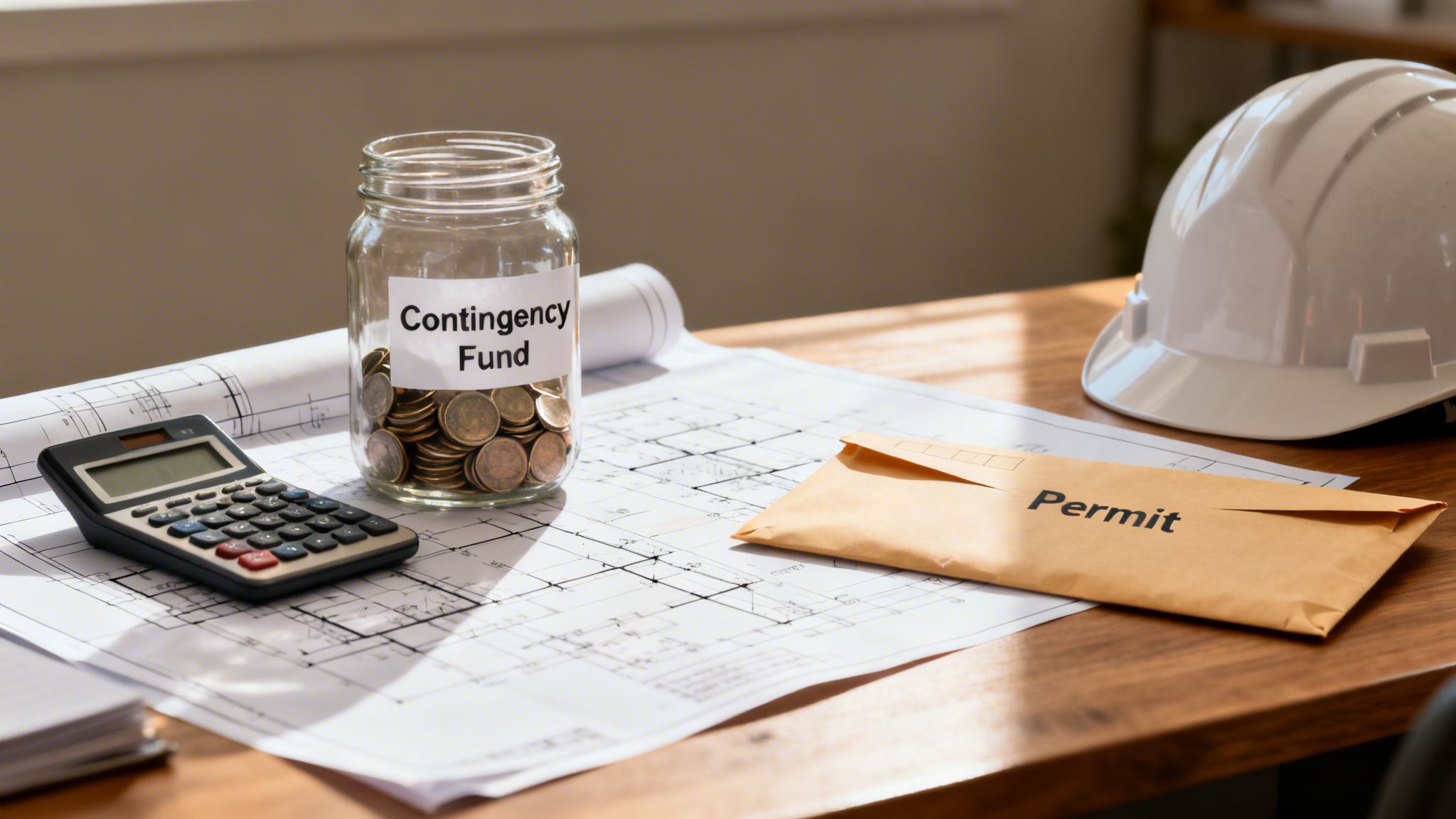
It catches a lot of first-time homebuilders by surprise, but these soft costs can easily tack on an extra 20% to 30% to the direct construction price. The key is to plan for them from day one. That way, they’re not stressful surprises, but predictable line items in your financial plan.
Unpacking Your Soft Costs
Think of your soft costs as the project's brain and nervous system. They’re what guide and coordinate everything else. While your builder handles the muscles and bones of the house itself, these expenses cover the critical background operations that keep everything running smoothly.
Here are the most common ones you absolutely need to have on your radar:
- Architectural & Design Fees: This is what you pay for the creation of your blueprints—the master plan for your entire home. These fees can run anywhere from 5% to 15% of your total construction cost, depending on how complex the design is and the level of detail you need.
- Permits and Inspection Fees: Your local city or county has a say in what you build. They charge for building permits, septic permits, well permits, and a whole series of inspections at different stages. These fees are non-negotiable and can easily add up to several thousand dollars.
- Land & Surveying Costs: Before a single shovel of dirt can be moved, you need a land survey to mark out your property lines and understand the topography. This is absolutely critical for site planning and can flag potential issues—like drainage problems—that need to be solved upfront. If you want to learn more about getting your land ready, our guide on professional site clearing services is a great place to start.
- Utility Hookup Charges: This is the cost to connect your new home to the grid. We’re talking water, sewer, electricity, and gas. In developed neighborhoods, it might be straightforward, but in more rural spots, these fees can be substantial—sometimes running into the tens of thousands of dollars.
Trying to build without budgeting for these things is like setting sail without a rudder. You might have a great boat, but you have no real control over where you’ll end up.
The Non-Negotiable Contingency Fund
Beyond all those known soft costs, there’s one more financial tool that is absolutely essential: the contingency fund. This is your project’s financial safety net, money you set aside specifically for the things you didn’t see coming.
Think of your contingency fund as project insurance. You hope you never have to use it, but you would never start a major project without it. It’s what separates a well-managed build from a financial crisis.
No matter how perfectly a project is planned, surprises are just part of the process. It could be a solid week of rain that delays the foundation pour, a sudden spike in lumber prices, or even you deciding mid-build that you simply have to have those upgraded countertops you saw online. It happens.
A healthy contingency fund, usually 10% to 20% of your total construction cost, is what allows you to absorb these hits without derailing the whole project. It gives you the flexibility to solve problems, make those desired upgrades, and keep things moving forward with peace of mind. It’s the single best tool for making sure your dream home doesn’t turn into a financial nightmare.
Securing Financing and Getting an Accurate Estimate
Now that you have a handle on the major budget categories, the next step is actually getting the money to make it all happen. This is where your dream home starts the journey to becoming a real home, a process that involves lenders, warranties, and the all-important task of getting a solid, trustworthy estimate. Diligence is your best friend here.
Financing a new build isn't quite like buying a house that's already standing. Most people end up with a construction-to-permanent loan. Think of it as an all-in-one loan that pays for the construction phase and then, once the keys are in your hand, it automatically converts into a regular mortgage. Your lender will want to see everything—detailed plans, a comprehensive budget from your builder, and proof that you're financially solid enough for the project.
This kind of loan works in stages called "draws." The bank doesn't just hand over a lump sum. Instead, it releases funds to your builder as they hit specific milestones, like after the foundation is poured or the framing is finished. Before cutting each check, the bank will send an inspector to make sure the work is done right, which adds a nice layer of oversight for you.
Understanding Warranties and Your Protection
Once the last nail is hammered and you move in, you're not on your own. Your new home is covered by several layers of warranties—a safety net protecting different parts of your house for different amounts of time. It's crucial to know what's covered and who to call if something goes wrong.
First, your builder will provide a one-year workmanship warranty. This is their personal guarantee that everything from the framing to the paint job was done to a professional standard and is free of defects.
On top of that, you’ll get a whole stack of individual manufacturer warranties for specific components in your home. These typically include:
- Appliances: Your fridge, oven, and dishwasher will each have their own warranty.
- HVAC System: The furnace and air conditioner are covered directly by the manufacturer.
- Roofing: Shingle companies often offer long-term warranties against defects, sometimes for 25 years or more.
- Windows and Doors: These also come with their own specific warranties from the companies that made them.
It's your builder’s responsibility to hand over a folder with all this documentation when the project wraps up. Keep it in a safe place!
How to Get a Truly Accurate Build Estimate
A vague estimate is a huge red flag. A simple cost-per-square-foot number is just a starting point, not a contract. To get an accurate estimated cost to build a house, you need a builder who believes in total transparency.
A trustworthy estimate isn't a single number; it's a detailed, line-item document that breaks down every phase of the project. This transparency is the foundation of a good client-builder relationship.
Insist on a bid that itemizes the costs for site work, foundation, framing, MEP (mechanical, electrical, plumbing), finishes, and everything in between. Be very skeptical of bids that lean heavily on "allowances," which are basically just budget placeholders for things like flooring or light fixtures. If those allowances are unrealistically low, you're the one who will be paying the difference out of pocket. A detailed bid gives you the power to see exactly where your money is going.
As you start talking to potential builders, do your homework. We have a whole guide on how to choose a general contractor that can help. For now, make sure you verify that any builder you consider is properly licensed and fully insured. This is non-negotiable—it protects you from liability and proves they are qualified. The wider market also suggests a cautious approach; forecasts for 2026 show that U.S. construction spending on buildings is expected to grow just 1.0%, which barely keeps up with inflation and puts pressure on builders everywhere. You can read more on the AIA's consensus construction forecast to get a better sense of the economic climate.
Let's Build This Thing Right—Together.
Trying to figure out construction costs, market swings, and all the local building codes in Southern North Carolina can make your head spin. Honestly, it’s overwhelming. That's why having a builder you trust in your corner isn't just a good idea—it's everything. You shouldn't have to guess your way through an estimated cost to build a house.
At FHP Contracting, we've spent over a decade with our boots on the ground right here. We deal with the day-to-day headaches—the price changes, the permit paperwork, the tight deadlines—so you don't have to. Our job is to be your guide and your advocate, from our very first chat until we hand you the keys.
We’ve built our name on being completely transparent and keeping you in the loop. Building a home is a huge investment, and you deserve to know exactly where every dollar is going, every step of the way.
We’re Not Just Builders; We’re Your Neighbors
Our expertise isn't just about swinging hammers and pouring concrete; it's about building specifically in Southern North Carolina. We have deep roots here. We know this area, its quirks, and its opportunities like the back of our hand.
- We Know the Codes Cold: Forget about surprise inspection failures. We’re experts in the local and state building codes, which means your project stays on track and avoids those costly delays.
- Our Rolodex is Solid: After years in the business, we’ve built strong relationships with the best local suppliers and subcontractors. That helps us get quality materials and skilled hands on your project, even when things are busy.
- We've Built It Before: Whether you’re dreaming of a sprawling custom home, a practical barndominium, or even a multi-unit development, we have the real-world experience to make it happen.
That local know-how is what makes the difference. It lets us create budgets that are actually accurate from the get-go, spot potential problems with a piece of land before they become disasters, and push your project forward with confidence. We’re proud to be a fully licensed, bonded, and insured general contractor that doesn’t cut corners.
From Your Vision to Your Front Door
We don’t just build houses; we deliver on our word. Our entire process is built around giving you clarity and peace of mind, making sure your home gets built on time and on budget. Your vision is our blueprint.
A successful build is a team effort. We become your single point of contact, taking your ideas and turning them into a solid plan while managing the hundreds of tiny details it takes to bring it all to life.
The next step? Turning that dream into a real-world, actionable budget. The best way to do that is with a free, no-pressure consultation with our team. We’ll listen, answer your questions, and give you the straightforward advice you need to feel good about moving forward. Let’s build your vision, together.
Your Top Questions About Building a House in NC, Answered
Embarking on a new home build is a huge deal, and it's totally normal for it to bring up a lot of questions. Getting clear, straightforward answers is really the first step toward building your dream with confidence. Here are a few of the most common questions we hear from clients who are just starting to think about building a house here in North Carolina.
Is It Cheaper to Build or Buy a House in NC Right Now?
Honestly, this all comes down to what you're prioritizing. Buying an existing home might look cheaper on paper, but it often comes with a whole slew of hidden renovation costs. Not to mention, you'll likely have to make compromises on the layout, location, or the overall quality of the place. The true cost of an older home is its purchase price plus whatever you have to spend on necessary upgrades.
On the other hand, building a new home gives you complete control over every single detail—from the design and energy efficiency to the quality of materials—right from day one. While the initial estimated cost to build a house might seem higher, you're getting a home that's perfectly suited to you. That often translates to big savings on utilities and repairs for years to come.
How Long Does It Take to Build a Custom Home in NC?
From the day we break ground, you can expect an average custom home in North Carolina to take somewhere between 9 and 14 months to complete. Think of this as a good benchmark, but know that it can definitely shift based on a few key factors.
Things like the complexity of your home's design, how long the local permit approval process takes, unexpected weather delays, and the availability of certain materials or specialized trades can all influence the schedule. It's also important to factor in the pre-construction phase—this is where all the architectural design, engineering, and permit-chasing happens, which can easily add several more months to the total project timeline.
The most accurate timeline will always come from a builder who has a detailed construction schedule and a solid network of local subcontractors. This kind of proactive planning is what helps us manage and head off potential delays before they ever impact your move-in date.
What Are the Biggest Factors That Increase a Home Building Cost?
While literally thousands of decisions go into the final price, we've found that three areas consistently have the biggest impact on a new home's budget.
- Significant Land Preparation: The condition of your lot is a huge variable. If you've got a sloped site that needs extensive grading, require a complex septic system, or have to clear a ton of trees, your costs will go up before we even pour the foundation.
- Architectural Complexity: A simple, rectangular footprint is way more cost-effective to build than a design with lots of corners, angles, and complicated rooflines. Every little complication adds to both the material and labor bills.
- Level of Finishes: This is the cost driver you'll see the most. Making high-end choices like custom cabinetry, imported stone countertops, luxury flooring, and premium appliance packages can seriously elevate the final budget.
Ready to get clear and honest answers to your own questions about building a home? The team at FHP Contracting is here to help you navigate the entire process with confidence. Contact us today for a free consultation and let's start building your vision.