
When you start planning a custom home, one of the biggest question marks is the material cost. It’s a huge piece of the puzzle. In my experience, the real cost of materials for building a house usually eats up about 50% of your total construction budget.
That often translates to anywhere from $50 to over $100 per square foot. But that number isn’t set in stone. It’s a moving target, bumped and nudged by everything from your home’s design to what’s happening with global supply chains.
Your 2026 Building Material Cost Explained
Think of your material budget as the financial blueprint for your home. It’s the foundation for every other decision you'll make. Getting a handle on the big-picture numbers first helps you avoid nasty surprises and lets you put your money where it matters most as the project moves along. The cost per square foot is a great starting point, but it's just that—a start.
The final price tag on all that lumber, concrete, and drywall is shaped by a whole slew of variables. A simple, rectangular house will always be cheaper to build than a sprawling, complex design full of custom angles, gables, and bump-outs. And where you build matters, too. Putting up a house in a dense, high-cost city versus a rural area will swing your expenses wildly before a single nail is hammered.
Key Factors Driving Your Material Costs
Market shifts are a huge wild card. We all saw what happened with tariffs on Canadian softwood lumber a while back—geopolitical events can make material prices spike overnight. These kinds of external pressures really show why having a contingency fund and a contractor who knows the local market inside and out is so critical.
To give you a clearer picture of where all that money goes, we can break it down into a few main buckets. Here’s a general look at how your material dollars are typically split up.
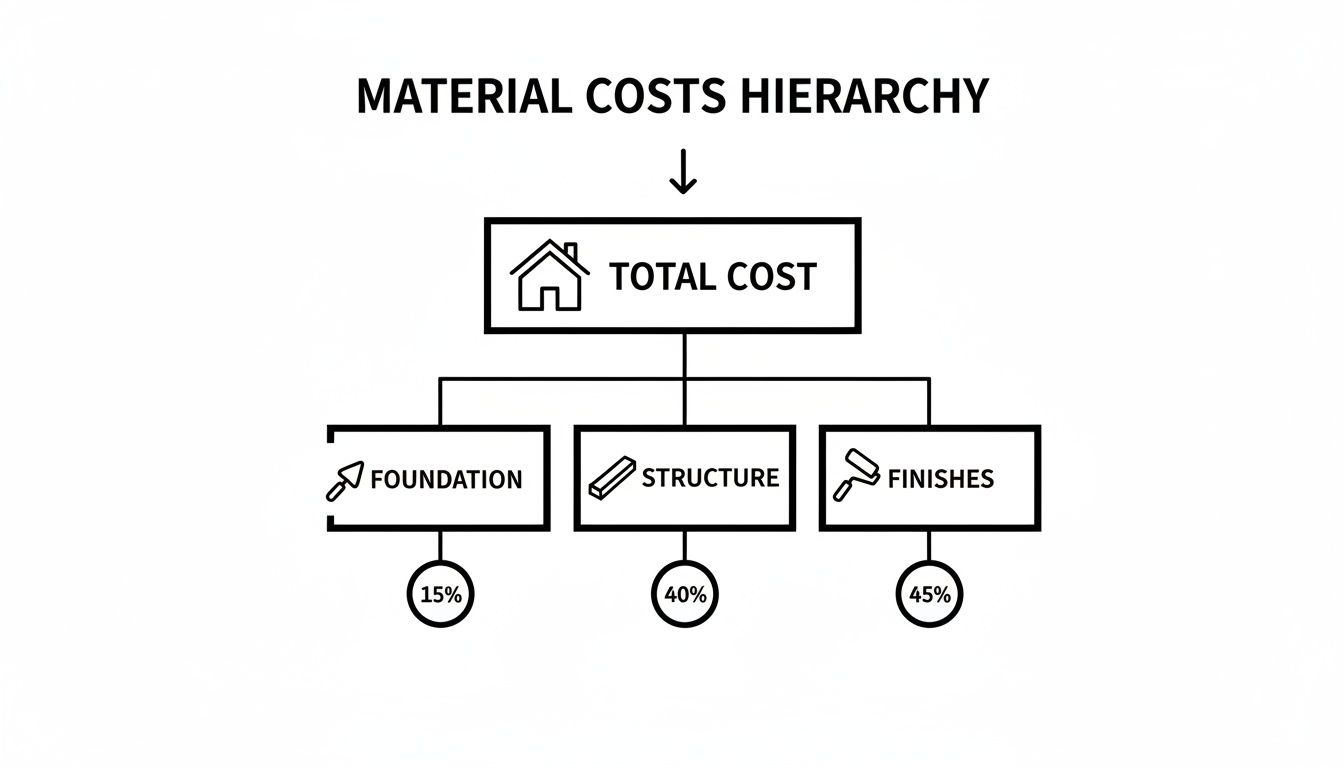
The infographic above gives you a solid visual, showing that the structural components—the skeleton of your home—make up the biggest initial investment. This is what sets the stage for the quality and integrity of the entire build. Following a detailed construction quality control checklist from day one is non-negotiable for success.
To make it even simpler, here’s a table that breaks down those percentages.
Estimated Material Cost Breakdown for a Standard Home
| Material Category | Percentage of Total Material Cost |
|---|---|
| Foundation & Structure (Concrete, lumber, steel) | 30-40% |
| Exterior Finishes (Siding, roofing, windows, doors) | 15-20% |
| Interior Finishes (Drywall, flooring, cabinets, paint) | 20-30% |
| Systems (HVAC, plumbing, electrical) | 10-15% |
As you can see, the "bones" of the house demand the largest share of the material budget. Getting this phase right is everything.
The main thing to remember is that the cost of materials isn't just a single number; it's a dynamic range. It’s a puzzle you piece together from your design choices, your location, and the bigger economic climate. Mastering your budget really comes down to understanding how each of those pieces affects the final picture.
Now, let's dive into each of these categories so you can build out your budget with confidence.
Building Your Home’s Skeleton
Every great home starts with a strong skeleton—its foundation and framing. These are the very first major expenses you'll run into, and they are absolutely critical. You can't skimp here. Just like a human skeleton, the foundation and frame have to support everything that comes after.
The choices you make at this stage will send ripples through your entire project budget. A solid, well-built structure isn't just a good idea; it's non-negotiable. Understanding the real-world cost of materials for building a house right from the get-go is what sets you up for a successful build.
Pouring the Foundation
Your home’s foundation is what literally anchors it to the ground, giving it a stable base to fight against shifting and settling over the years. This crucial first step typically runs from $5,000 to $15,000, though the final number can swing wildly based on the soil, your local climate, and the house design itself. And before a single drop of concrete is poured, the land has to be ready. If you're building on an untouched lot, you might need professional site clearing services to deal with trees, boulders, and general debris, which will be an added upfront cost.
You’ve got a few main choices for your foundation, and each has its own price tag:
- Concrete Slab-on-Grade: This is exactly what it sounds like—a single, solid layer of concrete poured directly onto the prepared ground. It’s usually the most budget-friendly path, costing around $5 to $14 per square foot, and is a popular choice in warmer climates with stable soil.
- Crawlspace Foundation: This option lifts the house a few feet off the ground. You get a small, accessible space underneath—a lifesaver for running plumbing and wires. It costs more than a slab but can save you major headaches with future maintenance and keeps the house away from ground moisture.
- Full Basement: This is the most expensive route, involving some serious excavation. The trade-off? You gain a massive amount of usable square footage, which can be finished into living space, a workshop, or anything else you can dream up.
The right foundation often comes down to where you live. For instance, if you're in an area with a high water table or sandy soil, you'll likely need a specific—and often more expensive—type of foundation to guarantee long-term stability.
Assembling the Frame
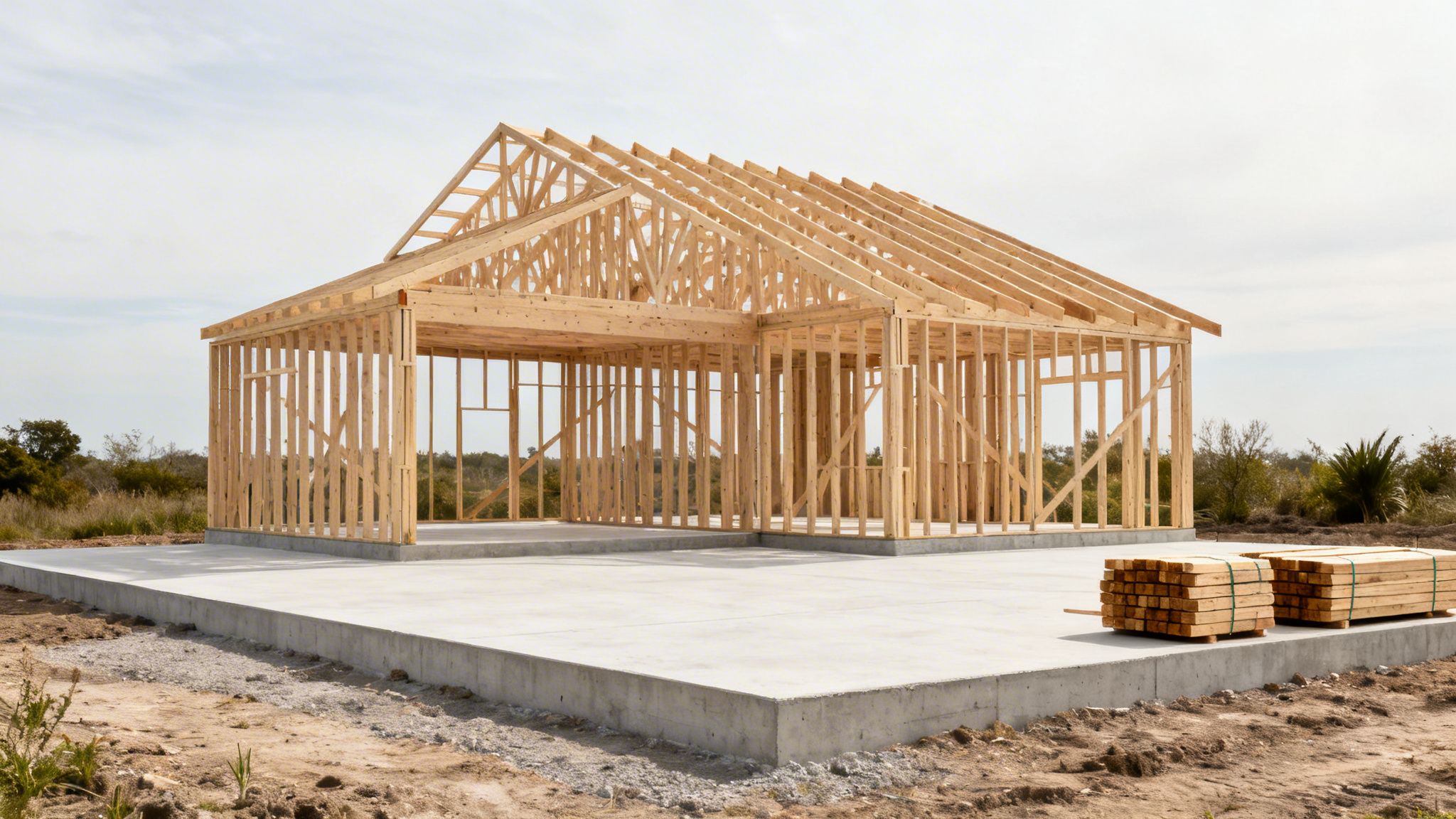
Once your foundation is cured and ready, it’s time to raise the walls. The frame—which includes the walls, floors, and roof structure—is what gives your home its actual shape. This is where your blueprints start to look like a real house. Framing materials and the labor to put it all together typically account for $11 to $30 per square foot of your home's total area.
Think of your home’s design as its bone structure. An open-concept living area with long, uninterrupted spans requires larger, stronger—and more expensive—beams. Adding a second story or complex rooflines is like increasing the "bone density," which directly raises the material costs for your home's skeleton.
The materials you choose for framing also play a huge role in the final cost:
- Traditional Lumber (Stick-Built): This is the classic method, using standard 2x4s and 2x6s. It’s what most people picture when they think of a house being built. The catch is that softwood lumber prices can be incredibly volatile, swinging based on things like trade tariffs, which can tack on thousands of dollars to an average build.
- Engineered Wood: Products like I-joists and laminated veneer lumber (LVL) are manufactured to be incredibly strong and consistent. They’re perfect for those wide-open floor plans because they can span longer distances than traditional lumber, but you'll pay more for them upfront.
- Insulated Concrete Forms (ICFs): This system uses hollow foam blocks that are stacked like Legos and then filled with steel-reinforced concrete. An ICF home is amazingly well-insulated and tough as nails, but it represents a much bigger initial investment compared to wood framing.
Ultimately, your framing package is a direct reflection of your home's complexity. A simple, rectangular house will always be cheaper to frame than a custom design loaded with gables, bay windows, and funky rooflines. Every extra corner and angle means more materials and more labor hours to get it all assembled.
Defining Your Home’s Exterior Shell
Once the structural skeleton is standing tall, it's time to give your home its protective skin—the exterior shell. This is where your home's personality and curb appeal truly come to life. It's also your primary defense against rain, wind, and sun. The materials you pick for the roof, siding, and windows are some of the most visible parts of your build, and their costs can swing wildly. This whole phase typically eats up 15-20% of your total material budget.
But these choices are so much more than just cosmetic. They determine how your home performs over the long haul, affecting everything from your heating and cooling bills to how much maintenance you’ll be doing on weekends. The trick is to think about these materials as one integrated system, not just separate pieces. That's how you strike the right balance between your budget and your dream design.
Choosing Your Roof
Your roof is the ultimate protector, the first line of defense against whatever nature throws at it. It’s no place to cut corners. A new roof can run anywhere from $6,000 to $18,000 or more, a range driven almost entirely by the material you choose.
Let's break it down with a "good, better, best" approach:
- Good (Budget-Friendly): Asphalt Shingles. There’s a reason these are the most common roofing material in the country. They’re affordable and relatively simple to install. The trade-off is a shorter lifespan, usually around 15-30 years.
- Better (Mid-Range): Metal Roofing. Once just for barns and commercial buildings, metal roofs are having a moment. They're incredibly durable, offer a sleek, modern look, and can last 50 years or more. They cost more upfront but deliver fantastic long-term value.
- Best (Premium): Clay or Slate Tiles. For that timeless, high-end aesthetic, nothing touches tile or slate. They are unbelievably durable, totally fireproof, and can last a century. But this quality comes at a price—they’re the most expensive option and need a reinforced roof structure to handle their serious weight.
Selecting Your Siding
Siding does for your walls what the roof does for the top of your house: it protects them and defines your home's entire style. Siding costs generally fall between $4 to $13 per square foot. For a 2,000-square-foot home, that means a siding bill somewhere between $8,000 and $26,000.
Think of your home's exterior as its wardrobe. You can choose a practical, everyday outfit (vinyl siding) or a durable, high-performance suit (fiber cement). Each choice has a different upfront cost and requires a different level of care over time.
We can apply the same "good, better, best" framework here:
- Good (Affordable): Vinyl Siding. This is the go-to budget choice because of its low cost and minimal maintenance. And forget the faded, cracked vinyl of the past; modern versions come in a huge range of colors and styles.
- Better (Durable): Fiber Cement Siding. Made from a tough mix of cement, sand, and cellulose fibers, this stuff is built to last. It’s fire-resistant, holds paint beautifully, and is a major step up in both performance and cost from vinyl.
- Best (Luxury): Brick or Stone Veneer. For maximum durability and a classic, premium look, nothing beats real brick or stone. It's the most expensive route, but it offers a timeless appeal and is virtually maintenance-free.
These exterior choices are also a huge piece of your home's thermal envelope, working hand-in-hand with your insulation. Don't forget that moisture management is just as critical. For example, understanding the benefits of crawl space encapsulation is vital for protecting your home’s structure from the ground up, complementing the work your siding does above.
The Value of Windows and Doors
It’s easy to overlook in the early budget stages, but fenestration—the fancy term for the arrangement of your windows and doors—is a major cost. More importantly, it has a massive impact on your home's energy bills for years to come.
Sure, standard vinyl windows are affordable. But upgrading to high-performance windows with double or triple panes, low-E coatings, and gas fills is one of the smartest investments you can make.
These top-tier windows might cost 15-30% more upfront, but they can slash your energy bills by a similar percentage every single year. Over the life of your home, that adds up to real savings, essentially paying for the upgrade and then some. It’s a perfect example of where a higher initial cost of materials for building a house directly translates into a lower cost of ownership down the road.
Powering Your Home’s Nervous System
Once the drywall goes up, a whole world of critical systems gets hidden from view. This is your home’s nervous system: the Mechanical, Electrical, and Plumbing (MEP) components that make a house a comfortable, safe, and truly functional place to live.
These systems are the lifeblood of your home. While they typically only make up 10-15% of your total material budget, this is absolutely not the place to cut corners. It’s a decision you’ll live with for decades.
Trying to save a few bucks on cheap HVAC equipment or bargain-bin wiring is a recipe for disaster. You’re inviting annoying performance issues, serious safety hazards, and the kind of eye-watering repair bills that can haunt you for years. Trust me, it’s far better to invest in quality from the get-go.
Heating and Cooling Your Home
Think of your Heating, Ventilation, and Air Conditioning (HVAC) system as the lungs of your home. It’s responsible for keeping the temperature just right and circulating clean air all year long. The costs here are mostly for the equipment itself and all the ductwork needed to move air around.
For a pretty standard 2,000-square-foot house, you can expect the materials for a basic HVAC setup—furnace, air conditioner, and ductwork—to run you somewhere between $4,000 and $8,000. The biggest factor, unsurprisingly, is the size of your home. A bigger house needs a more powerful unit and a whole lot more ducting to reach every room.
You can also upgrade to higher-efficiency systems. They cost more upfront, but the long-term savings can be substantial:
- Zoned HVAC Systems: These are fantastic. They let you control the temperature in different parts of the house independently, so you’re not wasting energy heating or cooling rooms you aren’t using. The extra dampers and thermostats do add to the initial price tag, though.
- Geothermal Systems: These are the gold standard for efficiency, but they come with a hefty initial cost. The need for extensive underground piping puts their material cost well above traditional systems.
The Electrical Backbone
If HVAC is the lungs, then the electrical system is the brain and the nerves. It powers absolutely everything, from the lights in your ceiling to the phone charger by your bed. When we talk about the cost of materials for building a house in this category, we're talking about all the wiring, breakers, outlets, switches, and the main service panel.
For a new build, you're typically looking at an electrical material cost between $3 and $5 per square foot. So, on that same 2,000-square-foot home, that works out to about $6,000 to $10,000 for all the electrical guts.
That number can creep up quickly if you start adding in custom features like:
- A ton of recessed can lights
- Smart home automation systems
- Dedicated circuits for a power-hungry workshop or home theater
- An electric vehicle (EV) charging station in the garage
The global market for building materials remains dynamic and can impact local prices unexpectedly. For instance, Japan's market is currently seeing steep hikes of 14-16% for MEP components due to labor shortages and energy costs. Such trends highlight why early and agile procurement planning with a trusted local contractor is essential for managing your budget effectively. You can learn more about the global construction cost outlook and see how international trends can influence your project.
Plumbing In and Out
And finally, we have the plumbing—your home's circulatory system. It brings in fresh, clean water and carries wastewater away. The material costs here can swing wildly depending on the size of your house, how many bathrooms and kitchens you have, and, most importantly, the quality of fixtures you choose.
The "rough-in" plumbing materials, which are all the pipes and drains hidden behind the walls, usually cost between $4,000 and $7,000 for an average home. This covers materials like PEX or copper for supply lines and PVC for the drain lines.
The real budget variable comes from the fixtures—the faucets, sinks, toilets, and showers you’ll be looking at and using every single day. You could spend $300 on a perfectly good toilet or $3,000 on a high-tech smart toilet with all the bells and whistles. A faucet can be $50 or $500. Another big choice is your water heater; a traditional tank model is affordable, but a tankless heater costs more upfront while offering endless hot water and energy savings over its lifetime. This is where your personal taste directly hits the final bill.
Bringing Your Vision to Life with Interior Finishes
If the structure and systems are the bones and nerves of your new home, the interior finishes are its personality. This is the fun part, the stage where a house really starts to feel like your home. Every choice, from the flooring under your feet to the faucet in the kitchen sink, reflects your personal style.
It's also where your decisions have a very real, very immediate impact on the budget.
Interior finishes usually eat up 20% to 30% of your total material budget. That’s a pretty big slice of the pie, but it’s also the area where you have the most control. This is your chance to play a strategic game of high-low—splurging where it counts and saving where it makes sense—to get a custom look without blowing your budget.
Walls and Ceilings
Before you can even think about paint swatches, you need the canvas itself. Drywall is the standard for finishing interior walls and ceilings, creating the smooth surface for all your final touches.
For a typical 2,000-square-foot home, expect to spend between $3,000 and $7,000 just on the drywall and its supporting cast of joint compound and tape. Paint is the next layer, and it can run $1 to $3 per square foot of wall space. That can tack on another $2,000 to $6,000, all depending on the quality of the paint and how many coats you need.
Think of interior finishes as a balancing act. You might decide to splurge on those stunning quartz countertops for the kitchen you've been dreaming of. To make it work, you could then opt for stylish but affordable laminate flooring in the bedrooms. This high-low approach is the secret to achieving a high-end feel while managing the overall cost of materials for building a house.
Flooring Choices and Costs
Flooring is one of the most significant material decisions you'll make, setting the tone for every single room. The costs here can swing wildly, from just a couple of dollars per square foot to well over $15.
Let’s look at a few popular contenders:
- Laminate Flooring: A budget-friendly champ, laminate costs about $2 to $6 per square foot. And honestly, modern versions do an incredible job of mimicking real wood or stone.
- Luxury Vinyl Plank (LVP): A step up in toughness and water resistance, LVP is perfect for kitchens, bathrooms, and basements. You're looking at $3 to $7 per square foot.
- Hardwood: The timeless classic. There's no denying the warmth and value hardwood adds to a home, but it comes with a higher price tag of $8 to $15 per square foot, and even more for exotic woods.
- Carpet: Still the coziest pick for bedrooms and family rooms. Carpet costs can range all over the place, from $2 to $12 per square foot depending on the fiber and pile you choose.
Kitchens and Bathrooms: The Big-Ticket Items
Kitchens and bathrooms are where your finish costs can really start to climb. Why? Two words: cabinets and countertops. These two elements are the stars of the show and represent a major part of your investment.
When it comes to cabinetry, you've got three main tiers:
- Stock Cabinets: These are mass-produced in standard sizes. They're your most affordable route, usually running $100 to $300 per linear foot.
- Semi-Custom Cabinets: Here you get more flexibility with styles, finishes, and sizes. They hit the middle ground at $150 to $650 per linear foot.
- Custom Cabinets: Built from scratch to your exact vision, these offer endless possibilities but are the priciest, starting at $500 per linear foot and going up from there.
Countertops follow a similar good-better-best cost story. Laminate is the most wallet-friendly, while materials like granite and quartz give you that premium look and durability for a premium price—often $80 to $150 per square foot installed.
It’s also crucial to remember that prices for these materials don't exist in a vacuum. Broader economic trends can and do have an impact. For example, U.S. residential building material prices recently saw a 3.5% year-over-year surge, the biggest jump since early 2023. You can discover more about these building material price trends to get a feel for how these cost pressures might ripple through your budget.
This reality of shifting costs brings us to a key concept your builder will use: allowances. An allowance is just a dollar amount set aside in your contract for items you haven't picked out yet, like light fixtures or backsplash tile. If you fall in love with a chandelier that costs more than your allowance, you'll be paying that difference out of your own pocket. Getting a handle on these allowances early on is absolutely key to staying on budget.
Smart Strategies to Budget and Save on Materials
Knowing your material costs is one thing, but actually keeping those numbers from spiraling out of control is where the real work begins. This is your playbook for managing the cost of materials for building a house without having to sacrifice the quality you want.
The first rule of any construction budget is to plan for the unexpected. Even the most detailed spreadsheet is just a guess until the materials are on-site. Professionals always build in a contingency fund—think of it as a financial shock absorber. A good rule of thumb is to set aside an extra 10-15% of your total material budget just for surprises, like a sudden price spike or realizing you need more of something than you originally thought.
And trust me, surprises will happen. The construction market can be a rollercoaster. For instance, some recent forecasts show steel prices jumping 13% and aluminum surging by a whopping 23% by 2026. A contingency fund is what keeps these market swings from derailing your entire project.
Practical Tips for Lowering Material Costs
Beyond having a safety net, you can make a few strategic choices early on that will have a huge ripple effect on your final bill. This isn't about being cheap; it's about building smarter.
Here are some of the most effective ways to save:
- Simplify Your Footprint: A straightforward, rectangular house is dramatically cheaper to frame and finish than a home with a dozen corners, complex gables, and an intricate roofline. Every extra angle adds both material and labor costs.
- Stick to Standard Sizes: Custom-sized windows and doors are beautiful, but they come with a hefty price tag. You can save thousands by opting for high-quality, standard-sized products right off the shelf, without giving up on style.
- Source Materials Locally: Buying from local suppliers is a triple win. It cuts down on expensive shipping fees, supports your community, and often gets you materials that are better suited for your specific climate.
The Power of Value Engineering
One of the most powerful tools in a builder's cost-saving arsenal is something called value engineering. This doesn’t mean just picking the cheapest option. It’s a much more thoughtful process.
Value engineering is a systematic method of analyzing materials and building systems to find the perfect sweet spot between performance, quality, and cost. It’s the art of achieving the exact same function and aesthetic for less money.
For example, it might involve swapping a specified siding for an equally durable alternative that costs 20% less, or redesigning the framing plan to use standard lumber lengths more efficiently, minimizing waste.
This is where a great general contractor proves their worth ten times over. An experienced builder has deep relationships with local suppliers and access to bulk pricing and discounts you simply can't get as an individual. They know which materials offer the best long-term value and can suggest smart substitutions you would never have thought of.
Ultimately, navigating material orders and budgeting is a full-time job in itself. A seasoned contractor doesn't just get you better prices; they apply their expertise to make every single dollar go further. If you're starting that search, our guide on how to choose a general contractor is a great place to start looking for the right partner to protect your budget and bring your vision to life.
So, What's This Really Going to Cost Me?
As your dream home starts to take shape on paper, the big, practical questions about the cost of materials for building a house inevitably start popping up. Let's dig into some of the most common worries I hear from clients, so you can move forward with a bit more confidence and clarity.
How Much Should I Budget for Overruns?
Here's a piece of advice I give everyone: even the most perfectly planned project will have surprises. It's just the nature of building. A smart budget always includes a contingency fund of 10% to 15% of your total material cost. Think of it as a financial shock absorber—it handles those unexpected price jumps or last-minute needs without throwing the whole project off the rails.
Can I Save Money by Buying Materials Myself?
This is a classic question, and I get why people ask it. On the surface, cutting out the middleman seems like a surefire way to save a buck. But in my experience, it almost never works out that way.
General contractors have spent years, sometimes decades, building relationships with suppliers. That gets them access to bulk pricing and trade discounts that simply aren't available to the public. More importantly, they know exactly what to order, how much, and when. Their expertise prevents incredibly costly mistakes, like getting the wrong type of lumber or running short on drywall right when you need it.
Trust me on this one: letting your builder handle material procurement is almost always the smarter, safer, and more cost-effective way to go. They take on the logistics, vet the quality, and wrestle with any supply chain hiccups that come up. That saves you not just money, but a world of headaches.
What Upgrades Actually Pay Off?
It's easy to get carried away with upgrades, but not all of them give you the same bang for your buck. If you're looking for the best return on your investment, focus on two areas that consistently add real value:
- Energy Efficiency: This one is a long-term win. High-performance windows, beefed-up insulation, and an efficient HVAC system might cost more today, but they'll pay you back with lower utility bills for as long as you own the house.
- Kitchens and Bathrooms: These are the heart of a home—and the rooms that truly sell houses. Investing in timeless cabinetry, durable countertops, and quality, modern fixtures is money well spent.
Ready to get a real, predictable budget for your vision? The team at FHP Contracting has the local know-how and supplier relationships to make your material budget work smarter, not just harder. We'd be happy to walk you through the numbers. Schedule your free consultation with us today.