

Construction risk management is just a fancy way of saying you’re identifying, assessing, and dealing with potential threats to your project's budget, schedule, and quality before they happen. It’s about turning all that uncertainty into a solid game plan, so a small oversight doesn't spiral into a full-blown, costly disaster.
Why "Winging It" Is No Longer an Option
Picture this: you're heading up a commercial buildout in Fayetteville. Everything's humming along, right on schedule. Then, a week of unseasonably heavy rain hits, and you discover a massive, unforeseen drainage problem. Excavation grinds to a halt for weeks.
Suddenly, you’re not just behind schedule. You’re bleeding money on idle equipment rentals, and that great relationship you had with the client is starting to feel a little strained. This is what happens, time and time again, when risk management is just a box to check instead of a core part of the job.
Putting out fires reactively is a fast track to budget overruns and, eventually, legal headaches. Proactive risk management, on the other hand, is a disciplined investment. It’s about methodically looking down the road, asking "what if," and already having the answers before the questions are ever forced on you.
The Real Cost of Looking the Other Way
The financial stakes are higher than they've ever been. It's not just a few thousand dollars here and there. Persistent uncertainty in the global construction industry is projected to vaporize $2.5 trillion in activity in 2025 alone.
A recent, eye-opening report from Currie & Brown found that, on average, companies lost 13.7% of their project pipeline last year simply due to risks they didn't manage. That translates to an average loss of about $2.1 billion per company. These are staggering numbers that show just how critical a structured approach is.
But this isn’t just about dodging a financial bullet; it’s about building trust. A solid risk management plan shows you know what you’re doing. It tells clients their investment is in capable hands.
For any client, whether it's a government agency or a couple building their first home, seeing a clear, documented risk plan isn't just about process—it's about peace of mind. It proves you're not just a builder, but a strategic partner dedicated to protecting their vision and their bottom line.
A Full-Circle Approach
Good risk management isn't something you do once and forget. It’s a continuous cycle that you stick with from the first sketch to the final punch list. This playbook is designed to walk you through each critical phase with real-world examples that hit close to home here in Southern North Carolina.
The whole process boils down to a few key stages:
- Identification: Pinpointing potential threats before they ever show up.
- Assessment: Figuring out how likely each risk is and how bad the damage could be.
- Mitigation: Creating strategies to either avoid, transfer, or reduce those threats.
- Monitoring: Keeping a constant eye on your risks and making sure your plans are actually working.
When you embrace this way of thinking, you stop just hoping for the best. You start planning for it, making sure every single project is built on a foundation of integrity and foresight.
What Could Go Wrong? Identifying and Assessing Project Threats
Every solid risk management plan kicks off with one simple, powerful question: "What could go wrong?"
But let's be honest, you can't just throw ideas at a whiteboard and call it a day. The real key is digging into the nitty-gritty specifics that can actually derail a project. You can't fix a problem you haven't found, which is why putting in the work here pays off tenfold down the road.
A good way to look forward is to first look back. I always recommend pulling historical data from similar projects, especially those right here in Southern North Carolina. What were the most frequent change orders? What really held up that commercial upfit in Hope Mills or the new residential development near Fort Liberty? That data is a goldmine for spotting what's coming next.
This kind of proactive thinking is everything. It’s a simple flow, but it’s critical.
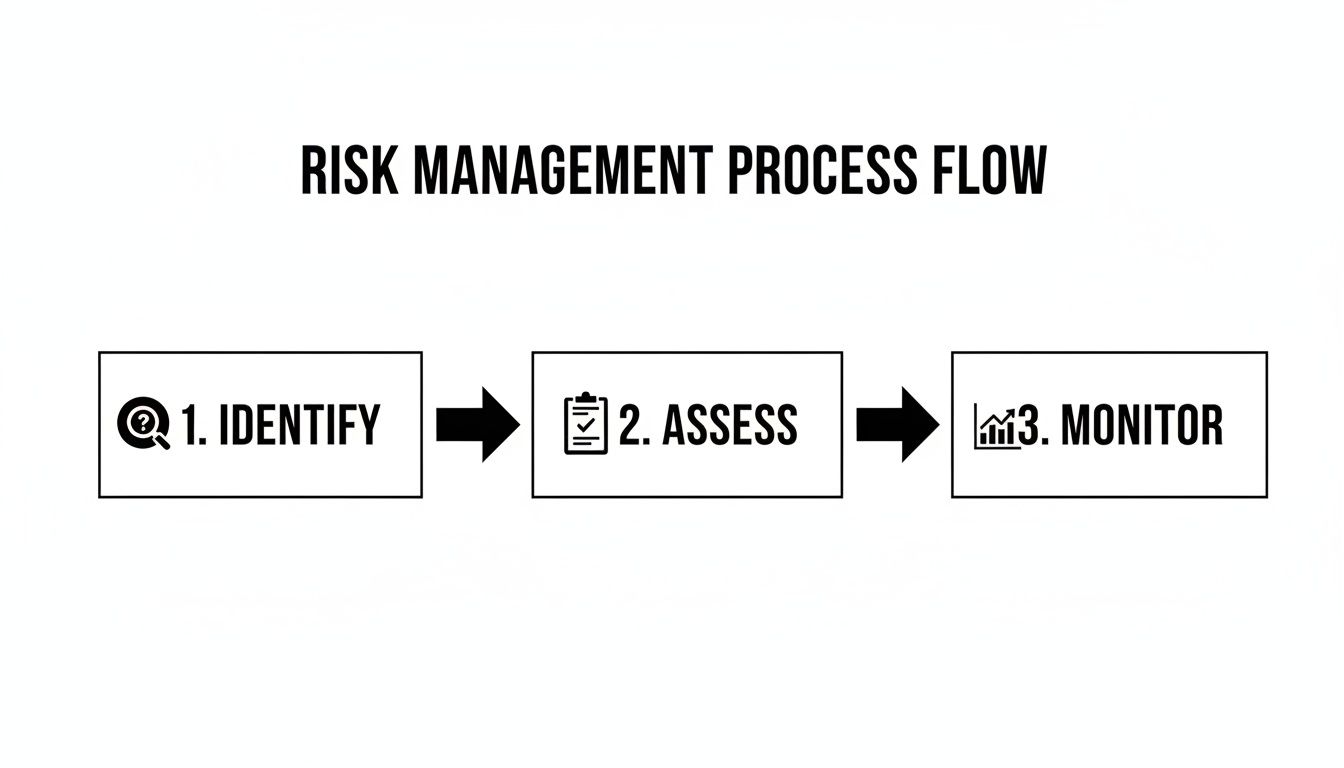
As you can see, finding the risks is just the start. From there, it's all about assessing them and keeping a constant watch to create a plan that can actually adapt and respond.
From List To Action Plan
Once you’ve got that master list of potential headaches, it’s time to sort them out. This is where you separate the minor bumps in the road from the absolute project-killers. This process usually splits into two paths: qualitative and quantitative analysis.
Qualitative Risk Assessment Matrix Example
This table is a practical example of how we score and prioritize risks. It’s a straightforward way to turn a long list of worries into a clear, prioritized action plan based on likelihood and potential impact.
| Risk Description | Likelihood (1-5) | Impact (1-5) | Risk Score (Likelihood x Impact) | Priority Level |
|---|---|---|---|---|
| Unexpected discovery of contaminated soil during excavation | 3 | 5 | 15 | High |
| Key subcontractor goes out of business mid-project | 2 | 5 | 10 | High |
| Permitting delays with the county planning department | 4 | 2 | 8 | Medium |
| Unseasonably heavy rainfall delaying site work | 4 | 2 | 8 | Medium |
| Theft of copper wiring from the job site | 3 | 2 | 6 | Medium |
| Minor material delivery delay (non-critical path) | 4 | 1 | 4 | Low |
This matrix immediately shows that contaminated soil and subcontractor failure are the fires we need to plan for first, even if one is less likely than the other.
Qualitative analysis is the go-to method for most situations because it’s fast and effective. You’re essentially ranking each risk using a simple scale (like low, medium, high) or numbers (1-5) based on two things:
- Likelihood: How likely is this thing to actually happen?
- Impact: If it does, how bad is the damage to our schedule, budget, or quality?
Multiply those two numbers, and you get a risk score. Suddenly, your priorities become crystal clear. A risk with a high likelihood and a high impact needs your immediate attention, while a low-low can just go on a watch list.
Knowing When To Bring In The Numbers
Quantitative analysis is the next level. This is where you put a hard dollar amount on the risk. It’s more complex and usually saved for the big, scary threats that could sink the budget.
For instance, you wouldn't run a detailed financial model for a minor fixture delay. But you absolutely would for the risk of steel prices jumping 20% over the next six months.
Think of it this way: qualitative assessment helps you decide which fires to watch. Quantitative assessment tells you exactly how much water you need to have on hand to put out the biggest ones.
A huge oversight I see all the time is failing to do a truly thorough site-specific hazard analysis right at the start. Just assuming the soil conditions are fine or that you know where all the utilities are can cause massive setbacks. For us, geotechnical surveys and utility locates before a single shovel hits the ground are non-negotiable. It’s a vital part of finding risks before they find you. You can learn more about how we get sites ready with our guide on professional site clearing services.
This level of detailed prep is more important now than ever. Take competition risk, for example. According to Aon's 2025 Global Risk Management Survey, it has shot up 18 spots in the global risk rankings since 2023. Huge infrastructure projects are pulling in new players and making bidding wars more intense.
This means you can’t just win on price anymore. You have to prove you can manage risk and deliver with certainty. That external pressure makes having a rock-solid internal risk process absolutely critical.
Crafting Your Mitigation and Response Game Plan
Once you've identified and ranked the threats to your project, it's time to decide what to do about them. A list of risks is really just a list of things to worry about. A strategic response plan is what turns that worry into control. This is where we move from just thinking about problems to actively solving them.
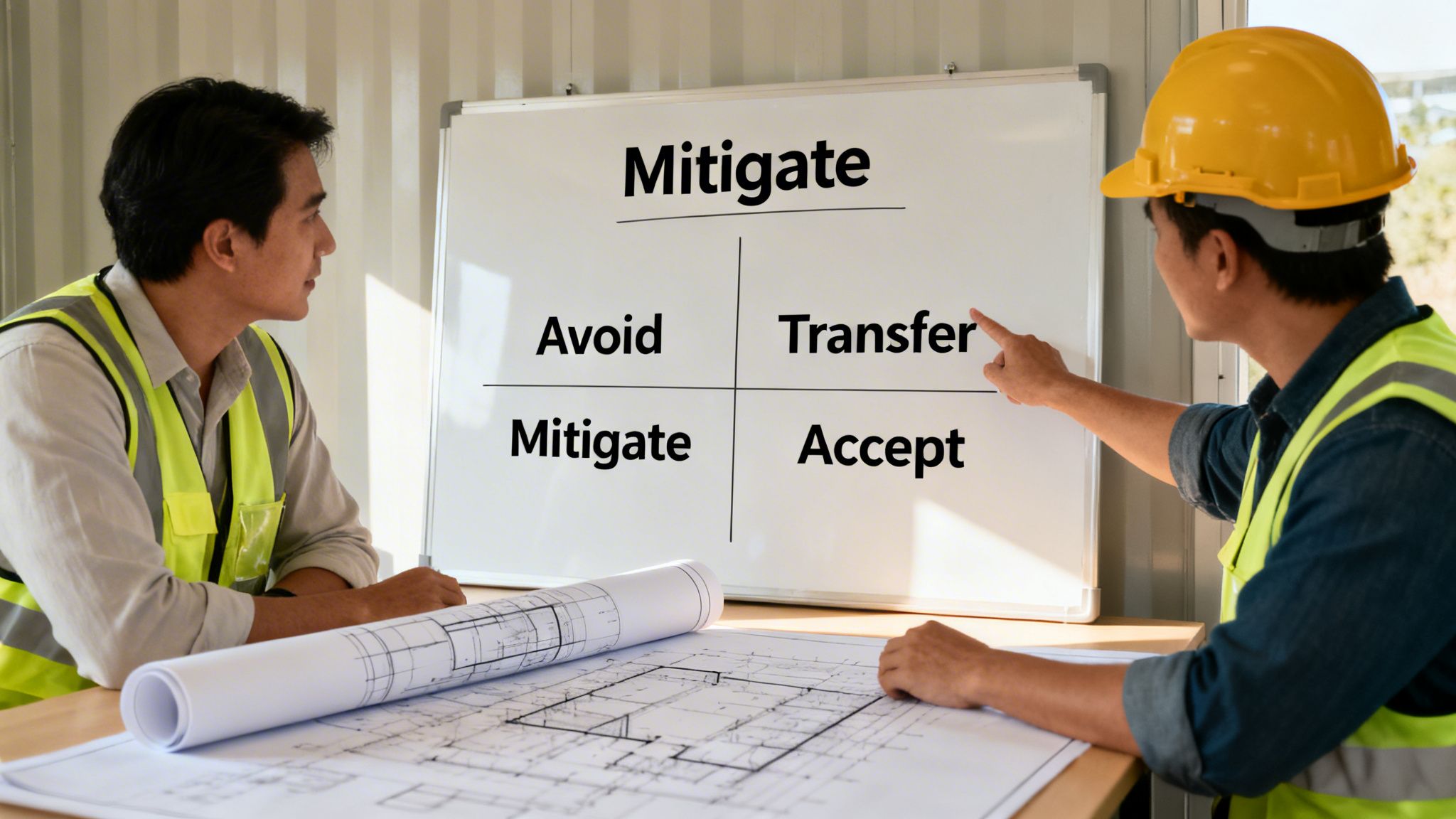
Simply put, you need a specific strategy for every single risk you’ve flagged. For every threat on your register, you’ve basically got four moves you can make. Picking the right one comes down to a gut check on the risk's severity, your project goals, and, of course, the budget.
The Four Core Risk Responses
Think of these four strategies as your playbook for handling the unpredictable. Each one gives you a different way forward, and the best risk management plans I've seen use a smart mix of all four.
- Avoid: This is the most straightforward play—you change your plan to sidestep the risk completely. It's not always on the table, but when it is, it's usually the most surefire fix.
- Transfer: Here, you're shifting the financial hit of a risk onto someone else's shoulders. The risk doesn't vanish, but it protects your bottom line if things go south.
- Mitigate: This is our bread and butter. Mitigation is all about taking steps to either make a risk less likely to happen or to soften the blow if it does.
- Accept: Let's be honest, sometimes the cost of fighting a risk is more than the potential damage. In those cases, you make a conscious call to accept it and deal with the fallout, usually by having a contingency fund ready to go.
Putting These Strategies to Work on the Job Site
Enough with the theory. Let's talk about how this stuff actually plays out on a real project here in Southern North Carolina.
Risk Scenario: Unstable Soil Conditions
You get the geotechnical report back for a new commercial build in Fayetteville, and it flags some potentially unstable soil. This is a huge red flag for foundation problems later on.
- Avoid: You could have the architects redesign the building's footprint, moving it to a more stable section of the property. This completely sidesteps the problem area.
- Mitigate: The more typical response is to bring in a soil engineer. They might design a beefier foundation with deep piles or recommend soil stabilization techniques to lessen the impact of the poor soil. Getting the foundation right from the start is non-negotiable, something we've seen time and again in our work on the benefits of crawl space encapsulation.
- Transfer: You could look into a specialized insurance policy, like latent defects insurance, which would cover the cost of fixing foundation failures after the project is complete.
- Accept: If the problem area is small and the risk is rated very low, you might just accept it. The key here is to allocate a specific contingency amount in your budget specifically for potential extra foundation work if it becomes necessary.
Picking the right response isn't just a technical decision; it's a business decision. Avoiding a risk might mean higher redesign costs upfront, but it could save you millions in rework and legal battles down the road. You have to weigh the cost of the fix against the potential cost of the failure.
Why Proactive Planning Is More Critical Than Ever
The need for this kind of strategic thinking is only growing. U.S. construction spending shot up to nearly $2 trillion in 2024, but that growth brings bigger and more complex headaches.
High-profile disasters have led to much tougher building codes, demanding better materials and more accountability from us contractors. As these insights about construction risks point out, cutting corners now can lead to massive fines, project shutdowns, and a world of trouble with your insurance carrier.
Building Your Response Checklist
To make your plan truly proactive, you need a clear, actionable checklist. Here’s a good place to start when you're mapping out responses for common risk categories.
Safety Risk Mitigation Checklist
- Run a mandatory daily safety briefing for every single person on site, including all subs.
- Verify that all workers have current certifications for the equipment they’re using. No exceptions.
- Install fall protection systems that go above and beyond the minimum OSHA standards.
- Schedule third-party safety audits at key project milestones to get a fresh set of eyes on potential hazards.
Budget Risk Mitigation Checklist
- Lock in fixed-price contracts with your key material suppliers to protect against price spikes.
- Get your purchase orders in for long-lead items the moment designs are finalized to lock in today's costs.
- Conduct a thorough value engineering review to find cost savings that don't compromise quality.
- Establish a rock-solid change order process to kill scope creep before it kills your budget.
By systematically using these four strategies—Avoid, Transfer, Mitigate, and Accept—and leaning on practical checklists, you turn risk management from a box-checking exercise into a genuine driver of project success. It's this kind of proactive thinking that not only protects your wallet and your schedule but also builds your reputation for being a contractor who's got it all under control.
Keeping Your Plan Alive: Monitoring and Contingency in Action
A risk register isn't a trophy you create at the start of a project and then mount on a wall. I've seen it happen, and it never ends well. The plan becomes obsolete the moment it's printed. The best risk management plans are living, breathing documents—dynamic tools that only have value if you use them day in and day out. Success comes from active, ongoing monitoring, keeping a constant pulse on the threats you know about while always looking for new ones.
This whole process is about creating a rhythm of accountability. It’s not about micromanaging your team; it’s about opening up clear communication channels so potential issues get flagged early and often. Sticking to a disciplined schedule for risk reviews is simply non-negotiable.
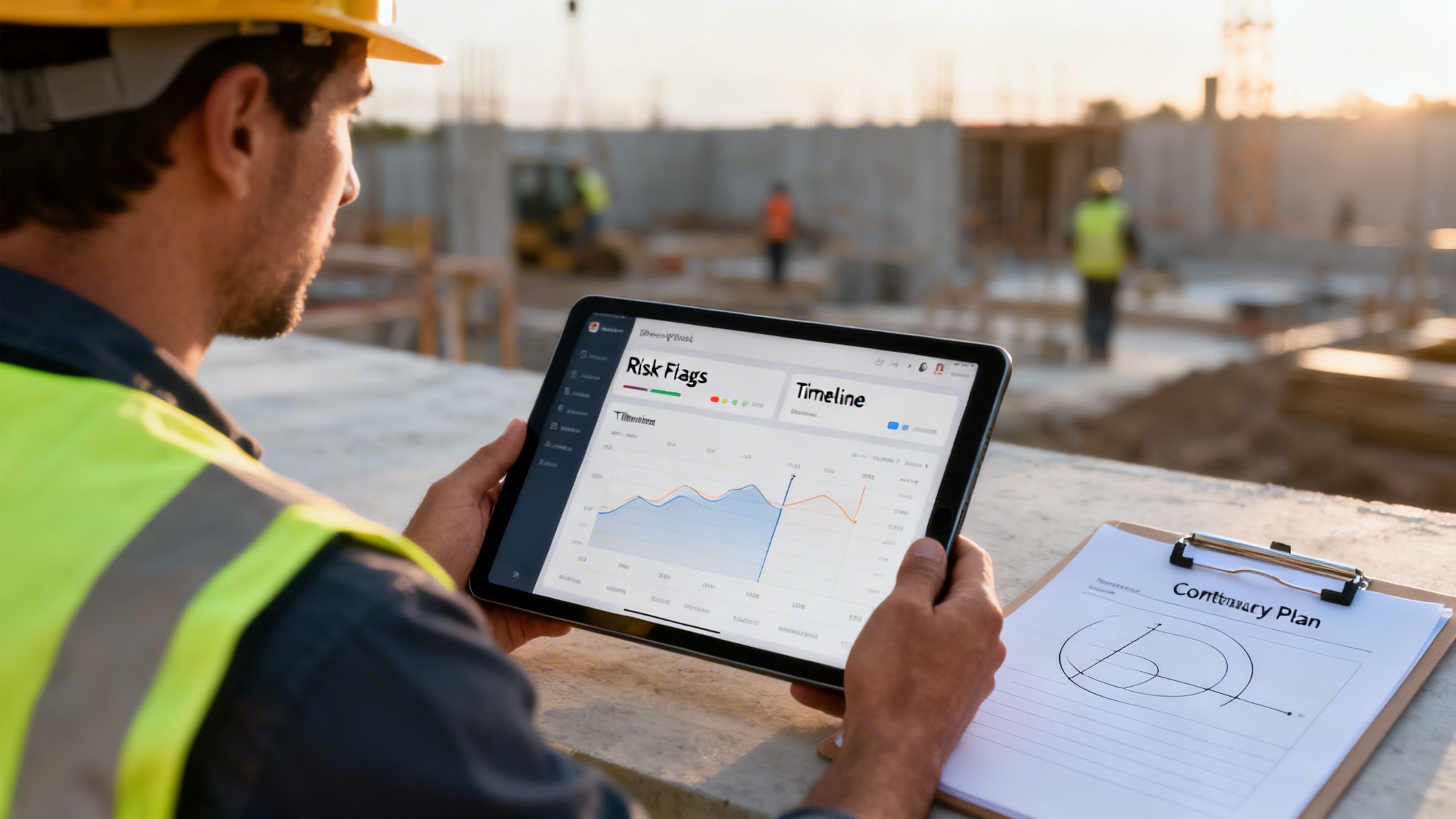
Establishing a Monitoring Cadence
You can't just "keep an eye on things." Effective monitoring relies on a consistent schedule of risk check-ins. Without a formal process, it’s far too easy for critical threats to fall through the cracks until they’ve already caused real damage.
Here's a rhythm that works:
- Weekly Team Huddles: These should be quick, stand-up style meetings focused on what’s right in front of you. Is a big storm rolling in that could delay a concrete pour? Did a key material delivery just get pushed back a few days? This is where the on-the-ground team syncs up on the immediate, near-term risks.
- Bi-Weekly Risk Register Reviews: This is a more formal sit-down with project managers and key stakeholders. You methodically walk through the high-priority items on the risk register, update their status, and confirm that your mitigation plans are actually being executed.
- Monthly Project Steering Meetings: At this higher level, the focus is on the big picture. You’ll present a summary of the top risks to leadership, discuss the overall health of your contingency funds, and address any significant new threats that have popped up on the radar.
The goal here is to focus on leading indicators, not lagging ones. A budget overrun is a lagging indicator—the damage is already done. A leading indicator? That might be a subcontractor who's consistently missing minor deadlines, signaling bigger delays are probably coming down the road.
The Two Buckets of Project Contingency
Once you start tracking risks, you need a financial plan to handle them when they hit. This is where contingency funds come in, but it's crucial to understand they aren't just one big slush fund. Smart financial risk management involves two distinct types of reserves.
Think of it like packing for a trip. Contingency reserves are the items you pack for predictable problems, like a rain jacket and an umbrella. Management reserves are the extra cash you bring for completely unexpected disasters, like your flight getting canceled. You need both to be truly prepared.
Differentiating between these two funds is a cornerstone of responsible project financial management. It brings clarity to stakeholders and ensures you have the right resources ready for the right kind of problem. A solid construction quality control checklist can also help you spot potential risks early, feeding directly into how you plan your contingency.
Calculating and Managing Your Reserves
Figuring out these funds isn't guesswork; it's a calculated part of your risk assessment. Each reserve serves a very specific purpose and needs to be managed accordingly.
1. Contingency Reserves for "Known Unknowns"
These funds are allocated to cover the costs of specific risks you’ve already identified in your risk register. For instance, if you know a project has a 10% chance of requiring an extra $50,000 in soil remediation, you'd calculate the expected monetary value ($5,000) and add it to your contingency reserve. You do this for all your prioritized risks.
- How it's calculated: A common starting point is 5-10% of the total project cost, but this figure should really be refined based on the sum of expected values from your quantitative risk analysis.
- Who authorizes it: The project manager usually has the authority to draw from this reserve to address identified risks as they occur, as long as it's properly documented.
2. Management Reserves for "Unknown Unknowns"
This is a completely separate pot of money set aside for the true, out-of-the-blue surprises that were impossible to foresee. Think of a sudden, unprecedented supply chain collapse for a critical component or a major zoning law change mid-project.
- How it's calculated: This is more often a flat percentage of the total project budget, commonly between 3-7%, depending on the project's complexity and overall uncertainty.
- Who authorizes it: Accessing these funds requires a much higher level of approval, typically from the project sponsor or executive leadership. This is critical to protect the reserve for genuine, high-impact emergencies.
By separating these funds, you create a transparent and disciplined approach. It prevents the budget for predictable hiccups from being wiped out by a single catastrophic event and gives stakeholders a clear, honest view of how project funds are being protected and deployed.
Tailoring Risk Management For Different Project Types
A solid risk management plan is never a one-size-fits-all document. The things that keep a project manager up at night on a custom home build in Moore County are worlds away from the compliance headaches of a government contract at Fort Liberty. Effective risk management means you've got to dig in and understand the unique pressures, priorities, and pitfalls of each specific project type.
Simply put, the checklist that works for a commercial tenant upfit in Fayetteville won't cut it for a new residential development. When you customize your approach, you’re moving from a generic safety net to a targeted strategy that anticipates the most likely—and most damaging—threats for that specific job.
This specialized focus is what really separates the pros from the pack. It shows you don’t just understand construction; you understand the client's world, whether it's their business operations, public obligations, or the personal investment they’ve poured into their dream home.
The Commercial Project Risk Profile
Commercial construction is all about the bottom line. Delays don't just push back a completion date; they postpone revenue, disrupt operations, and can tarnish a brand before the doors even open. The risk here is almost always tied to financial and operational impact.
Think about a restaurant upfit with a hard grand opening date. A two-week delay on a specialized pizza oven isn't just a scheduling hiccup. It's a direct hit to the owner's marketing budget and their initial revenue stream. Your mitigation plan has to be aggressive—maybe you’re pre-ordering that oven months in advance or you’ve already got two alternative suppliers lined up, just in case.
On a commercial project, time is more than money—it's market share. Every risk must be viewed through the lens of business continuity. A core part of the risk plan is to ask, "How does this threat impact the client's ability to operate and generate revenue?"
Top Commercial Project Risks Checklist:
- Business Disruption: Is our noisy work or site access going to impact adjacent, operational businesses?
- Tenant-Specific Requirements: What happens when the client makes last-minute changes to accommodate specialized equipment or layouts?
- Supply Chain Volatility: What’s our backup plan for critical path items like custom storefront glass or HVAC units?
- Code Compliance Ambiguity: How are we navigating conflicting or newly updated local commercial building codes?
- Access and Logistics: How do we manage deliveries and site access in a busy commercial center without snarling traffic?
Navigating Government and Public-Sector Contracts
Government projects play by a completely different set of rules. The biggest risks are often buried in paperwork, not in the soil. Compliance, documentation, and navigating endless layers of bureaucracy are the name of the game. A single missing form or a misstep in reporting can bring a multimillion-dollar project to a grinding halt.
Here, the focus shifts from pure speed and budget flexibility to meticulous, almost obsessive, adherence to process. A contract with Fort Liberty, for example, will have ironclad security, safety, and reporting requirements that are completely non-negotiable. The risk isn't that a sub will be late; it’s that their background check wasn't processed through the right channel, barring them from the site entirely.
Mitigation for government work means creating systems of extreme documentation. We’re talking daily reports, certified payroll, and a flawless change order process that can withstand the most intense audit. Your plan has to value administrative precision just as highly as build quality.
The Unique Challenges of Residential Projects
Residential construction, especially custom work like a barndominium or a major whole-home remodel, introduces a powerful and often unpredictable variable: the homeowner. The risks here are deeply personal and emotional. Honestly, managing homeowner expectations is often the single most critical task on the job.
A client sees a photo on social media and suddenly wants to change a tile that has a three-month lead time. This isn’t a simple change order. It's a risk that can blow up the schedule and budget, and it can seriously damage the client relationship if you don’t handle it with care and crystal-clear communication.
A residential risk plan has to be built around communication and education.
Key Residential Risk Mitigation Strategies:
- Material Selection Deadlines: Set firm, early deadlines for all client selections—tile, fixtures, paint colors—and clearly communicate the schedule impact of any changes.
- Weekly Progress Walkthroughs: Schedule a standing meeting on-site every week to review progress, answer questions, and deal with concerns before they have a chance to fester.
- Visual Change Orders: Use a detailed change order form that shows the cost, the schedule impact, and a clear "before and after" description so the homeowner knows exactly what they're approving.
This kind of proactive communication turns potential fights into collaborative decisions. It protects the project's timeline and, just as importantly, the client's peace of mind.
To really bring this all together, it's helpful to see the key differences side-by-side. Each project type forces you to wear a slightly different hat and focus your attention on what matters most to that specific client and contract.
Key Risk Differences Across Project Types
| Project Type | Primary Risk Drivers | Key Mitigation Focus |
|---|---|---|
| Commercial | Financial & Operational Impact. Delays directly affect revenue, tenant occupancy, and business continuity. | Aggressive Scheduling. Proactive supply chain management and contingency plans for business disruption. |
| Government | Compliance & Bureaucracy. Strict adherence to regulations, extensive documentation, and navigating multi-layered approval processes. | Meticulous Documentation. Flawless reporting, certified payroll, and a rigid change order process to withstand audits. |
| Residential | Client Emotions & Expectations. Scope creep from homeowner changes, communication breakdowns, and personal budget constraints. | Proactive Communication. Firm selection deadlines, weekly walkthroughs, and clear, detailed change order management. |
Understanding these distinctions is the first step. By starting with the right mindset for the job—whether you’re focused on business impact, bureaucratic process, or homeowner psychology—you can build a risk management plan that actually works in the real world.
Think of Us as Your Risk Management Partner
At the end of the day, managing risk on a construction project is so much more than a procedural checklist. It’s a living, breathing commitment to building certainty into your project from the ground up.
From sniffing out threats buried in a soil report to keeping a close eye on the subtle shifts in material costs, every piece of the puzzle—identification, assessment, mitigation, and monitoring—has to work together. This is what protects your investment and brings your vision to life safely, on time, and on budget. It's how you turn potential disasters into bumps in the road.
This is how we approach every single project, whether it's commercial, government, or residential work here in Southern North Carolina. We don’t just react to problems; we build a strategic shield around your goals from day one, making sure every decision is informed and every "what-if" is planned for.
Ultimately, your builder should be your most valuable risk management advisor. Honestly, choosing the right one is the very first, and most critical, step in protecting your project. If you want to know more about what to look for, check out our guide on how to choose a general contractor.
Let’s talk about the specific risks and unique opportunities for your project. We're ready when you are.
Got Questions? We've Got Answers.
If you're thinking about construction project risk management, you're not alone. We get asked about this stuff all the time. Here are some of the most common questions we hear from clients across Southern North Carolina.
What Is The Single Biggest Risk In Most Construction Projects Today?
That's a tough one, as every project is different, but lately, the one thing tripping up nearly everyone is material price volatility and supply chain chaos. It's a huge problem. You can have a perfect budget, but unpredictable costs for essentials like lumber, steel, and electrical components can throw a wrench in the works fast.
This is exactly where a solid risk management plan proves its worth. We're talking about strategies like locking in prices with suppliers early on, pre-purchasing materials if you've got a place to store them, and making sure contracts have clear price escalation clauses. Most importantly, it means setting aside a specific financial contingency just for material costs.
How Much Should I Budget For Contingency?
The old rule of thumb is 5-10% of the total construction cost, but honestly, that's just a starting point. The real number depends entirely on your project's unique risk profile.
- For a pretty straightforward residential remodel with all the plans locked down, 5% might be perfectly fine.
- But if you're taking on a complex commercial project, like renovating a historic building in downtown Fayetteville where you know you'll find some surprises, a contingency of 15% or even higher is a much smarter move.
Your general contractor should work with you to land on a realistic figure after digging into a proper risk assessment. It’s a conversation, not just a number you pull out of thin air.
Quick tip: A "contingency fund" is not a "slush fund." A contingency should be a calculated reserve tied to specific, identified risks in your plan. It’s there for the "known unknowns," not to cover for poor planning or because someone decided they want a different countertop last minute.
Can I Just Transfer All Construction Risks To My Contractor?
You can certainly use contracts and insurance to hand off a lot of the financial risks, and you absolutely should. But it’s impossible to transfer all of them. At the end of the day, some risks will always stay with the project owner.
For instance, if a project is significantly delayed, any damage to your business's reputation is on you. Or if you buy a piece of land and discover unforeseen site conditions later, that's a risk you own.
A great partnership with your contractor isn't about offloading every single risk onto their shoulders. It's about identifying, managing, and tackling them together. This kind of collaborative approach to construction project risk management is what gets everyone to the finish line successfully.
Ready to build a risk-resilient plan for your next project? The team at FHP Contracting is here to help you navigate the complexities and build with confidence. Let's talk about your vision and how we can protect it from day one. https://fhpcontracting.com